An empty law office at dusk, a brass desk lamp lighting a walnut desk where a phone lies face-up, its screen glowing

Law firm web design that brings in consultations

Good law firm web design does one job: it turns the people reading your site, most of them on a phone, into booked consultations for the cases you want. We build sites that look like the firm you really are and do that job from the first day.

Book a Call

$5,000 to $40,000, fixed in writing before we start.

Your website earns in two ways

Good law firm website design treats your site as something that brings in signed cases, not a brochure. It does that two ways: more of the people who land on it book a consultation, and more people find it when they search for the kind of case you take. Every site we build works on both from the day it goes live.

More of them book a consultation

Someone who needs a lawyer reads a few firm sites, then contacts the one that makes the next step feel easy. We write and lay out your pages around that decision: one clear way to book, the firm's real credentials right beside it, and nothing in the way.
About 2 in every 100 visitors booking, then about 8 in every 100. A music school in Denver, Colorado, not a law firm: 1.8% → 8.0% conversion rate. Client result, published on our homepage

More people find you

People search for the matter they have, not for your firm's name. We build every page to Google's own guidance, so your site is ready to be found for those searches when someone nearby needs the kind of help you give.

  • Speed Pages open quickly, even on a weak phone signal.
  • Mobile Every page is laid out for a phone first, then a desk.
  • Structure Clear headings and one page per topic, so Google can tell what each page is about.

Our work KM Law, Denver, Colorado

A Denver family law firm that stopped looking like everyone else

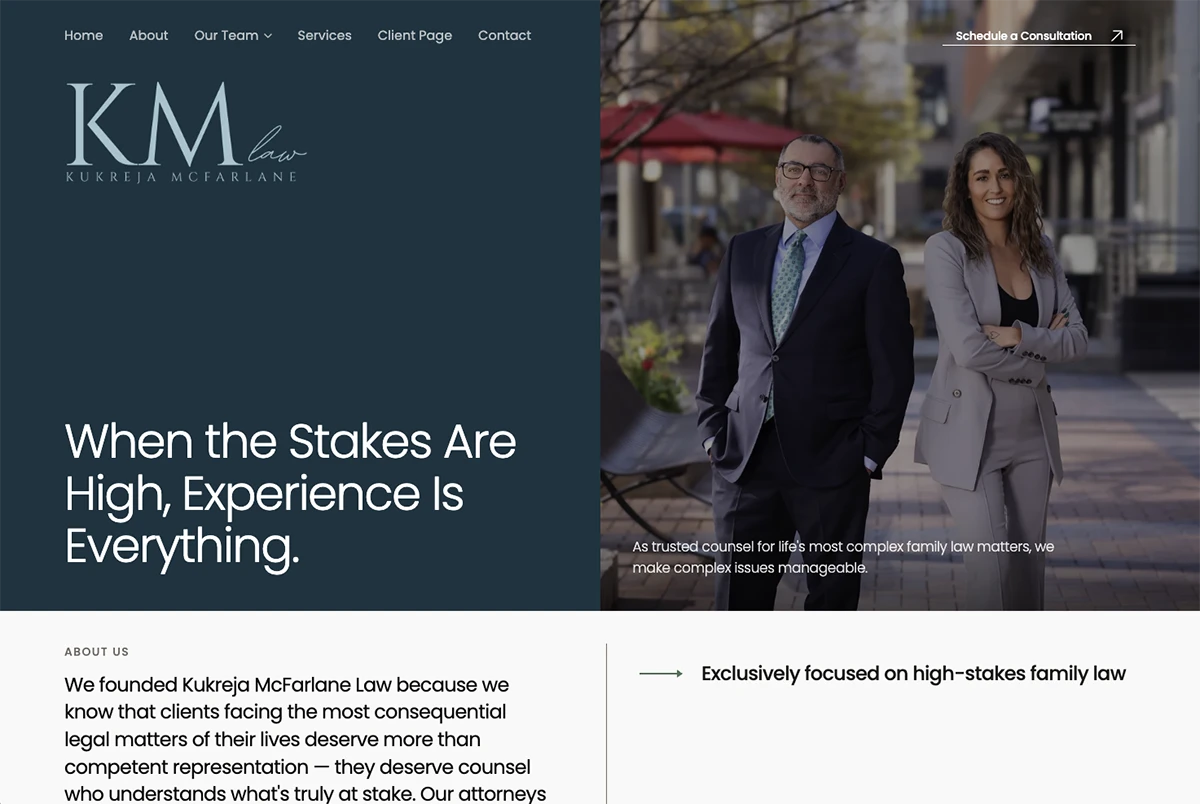
KM Law (Kukreja McFarlane) takes high-asset divorce and complex custody cases in Denver. Their old site could have been any family law firm's: stock photos and copy that said nothing in particular.

Our law firm web design for them started from the cases they really take. The new site is calm and sure of itself, with no flash, and every page leads to one step: scheduling a consultation. Law and wealth offices in Arizona will find the same approach on our page about web design in Scottsdale.

10 pages
Four practice areas, two partner bios, contact and a link to the client portal.
99/100
Mobile speed on Google's Lighthouse test. It opens in under a second on a phone.
0
Third-party trackers, chat widgets or popups. Nothing gets between a reader and the consultation button.
3 weeks
To build the whole site, start to finish.
See how we built the KM Law site

A page for each kind of case you want more of

At 11 p.m., nobody types your firm's name. They type their problem: custody lawyer, DUI attorney near me. One Practice Areas page with a list of headings gives Google nothing to match that search, and gives the person reading it nothing that sounds like their own situation.

So when we do web design for law firms, every kind of case you want more of gets its own page, written the way your clients talk about it: what happens, what it usually takes, who at the firm handles it, and how to book a consultation.

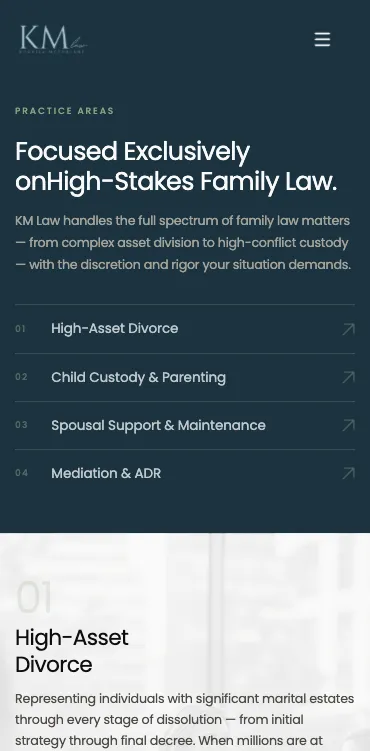
  1. High-Asset Divorce

    The question it answers

    We own a business and a house. How do they get divided?

    On the page

    • What happens
    • What it usually takes
    • Who at the firm handles it
  2. Child Custody & Parenting

    The question it answers

    How is parenting time decided, and what should I do first?

    On the page

    • What happens
    • What it usually takes
    • Who at the firm handles it
  3. Spousal Support & Maintenance

    The question it answers

    Will there be support to pay or receive, and for how long?

    On the page

    • What happens
    • What it usually takes
    • Who at the firm handles it
  4. Mediation & ADR

    The question it answers

    Can we settle this without going to court?

    On the page

    • What happens
    • What it usually takes
    • Who at the firm handles it

Illustration: four family law practice areas, each given its own page and the same clear last step.

A bio behind every page

Each practice page names the lawyer who handles those cases and links to their bio. The bio sets out the credentials that lawyer really holds, plainly, and nothing goes live until the firm has approved every word of it.

Plan your practice pages on a call
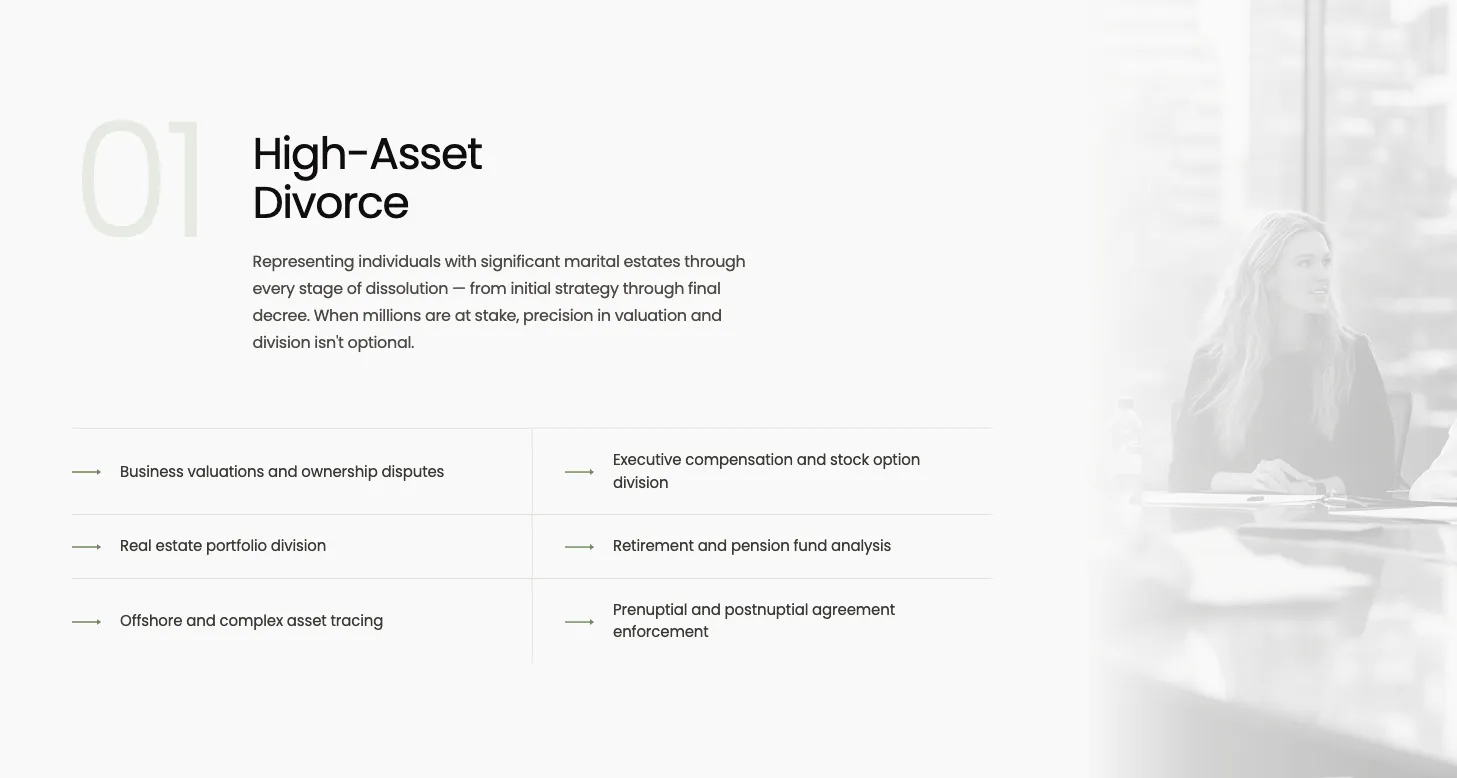
KM Law's High-Asset Divorce write-up: a short summary and six kinds of matter the firm takes
From a site we built: KM Law's High-Asset Divorce write-up, listing the matters the firm really takes.

Fast, quiet and private on a phone

Most firm sites run on WordPress or a legal-marketing template, with plugins, trackers, a chat widget and a popup piled on top. Someone reading on a phone waits for all of it to load, then has to close half of it before they can find out who you are. This is what we leave off.

A typical firm page on a phone, sketched. What stays is the page itself and one way to book.

What comes off

  1. The popup It covers your page before anyone has read a word about you.
  2. The chat bubble It asks people to type out the details of their case to a widget, before they've decided to call you.
  3. The tracker tags Third-party scripts that record each visit and make every page slower to open.
  4. The plugin weight Sliders, badges and add-ons that load on every visit and push the booking button down the screen.

What's left Your page, and one button to book a consultation.

Built in Astro, so the page arrives finished

A templated site is a theme, a page builder and a stack of plugins, and a phone has to load all of it to show one page. We build in Astro, which sends a plain, finished page with nothing extra to load. It opens fast on a phone, Google reads it easily, and there's no plugin or theme to keep patching.

That's how KM Law's site scores 99/100 for mobile on Google's Lighthouse test.

Nothing watches your visitors unless you choose it

People read a firm's site about things they haven't told anyone yet. We add no third-party trackers unless you ask for them, and no chat widget collecting case details. KM Law's site runs with neither.

The consultation form we set up for you asks only for what you need to call someone back: a name, a phone number or email, and the kind of matter. It also tells them plainly to keep confidential details out of it. Accounting firms need the same with tax documents, so our accounting website design sends those to the client's secure portal instead.

Two people write it with you, and you approve every word

The slow part of attorney website design is usually the words, and they usually land on a partner after hours. Not here. Bullfinch is two people, and we do the work ourselves, from the first call to launch day.

No account manager in between. You'll talk to both of us while your site comes together.

Kyle Rutten, Bullfinch's designer and developer, lit by a laptop screen in a dark room
Kyle Rutten Designs and builds your site Kyle built his first websites at 14 and has been designing and building them ever since. He's the one you talk to on the first call.
Katie Rutten, Bullfinch's project lead, working at a laptop in a dark room
Katie Rutten Runs your project Katie plans the dates and makes sure they hold. She looks after thirty-plus active clients, with every project on schedule.

How it runs

  1. A 30-minute call

    On Google Meet, with Kyle. Tell him about the firm, the cases you want more of, and what your current site isn't doing for you.

  2. The price in writing, within a week

    A fixed scope and a fixed price, written down before any work starts. No hourly billing.

  3. We interview the partners, then we write

    We ask the questions and you talk about your work the way you would to a new client. We write every page from that, so the site sounds like you without you writing it.

    For KM Law, we sat with the two partners until the practice-area copy sounded like them.

  4. You approve every word

    Nothing goes live until you've signed off on it, so the site says only what you're willing to put the firm's name to.

    • No promised outcomes
    • Credentials only as each lawyer really holds them
    • The disclaimers you tell us your state bar expects

    You know your bar's advertising rules. This is the step where you hold the site to them.

  5. Launch

    A typical site goes live in about 60 days. KM Law's took three weeks.

Book a Call

That's step one: 30 minutes on Google Meet.

Most of our sites cost $5,000 to $40,000

That's how we price every site we build, and law firm web design is priced the same way. Where your firm lands in it comes down to three things, and you'll see the exact figure in writing before any design work begins.

  • How many pages the firm needs

    Every practice area and every attorney you want found gets a page of their own.

    Toward $5,000A solo practice with two practice areas

    Toward $40,000Twenty lawyers across eight practice areas

  • What the site connects to

    Each thing it hands off to is built and tested before the site goes live.

    Toward $5,000A short consultation form

    Toward $40,000Consultation booking, a client portal link and intake forms

  • Whether we keep working after launch

    Ongoing SEO or Google Ads are optional. If you want either, it goes into the quote.

    Toward $5,000We hand the site over clean

    Toward $40,000Ongoing SEO or Google Ads

One price, written down, before we begin

No more than a week after our call, a written quote arrives: the pages, what the site connects to, anything after launch, and one price for all of it. The scope is set, so the price is too. No hourly meter while we work, and no surprise invoice at the end.

Book a call for your quote

On the call, tell Kyle your practice areas, how many attorneys you have and what the site has to connect to. That's most of what the quote needs.

What firms ask before they book

Five questions partners raise before the first call, with short answers. If yours isn't here, bring it to the call.

Ask Kyle on a call

Do we own the site?

Yes, all of it. The domain, the code and the hosting accounts belong to the firm, and you can move the site to any host or developer you like. Day to day, your staff change text, attorney bios and photos themselves in a simple editor we set up for you.

Can you move our existing pages and articles?

Yes. We bring over the pages and articles worth keeping, and every old address forwards to its new page, so the ones Google already shows people aren't lost in the move.

Will it follow our state's advertising rules?

It will say only what you've approved. Nothing goes live until you've signed off on every word, and we build in the disclaimers you tell us your state bar expects, on every page that needs them.

What happens after launch?

That's your choice. We can look after managed hosting and updates for you, with ongoing SEO or Google Ads if you want them. Or we hand the site over clean and it's yours to run. Either way, there's no plugin or theme to keep patching.

Do we need SEO too?

Not to launch. Being found on Google is part of lawyer website design, not an extra, so every site we build follows Google's own guidance from day one: quick on a phone, a page for each practice area, clear headings. Ongoing SEO is optional, for firms that want to be found for more searches over time. You can read about our SEO services first.

Thirty minutes about your firm’s site

Pick a time for a 30-minute Google Meet with Kyle. It's a working conversation about your site and your cases, not a presentation on law firm web design in general.

30 min Google Meet With Kyle Rutten

Loading availability

On the call

  1. Where your current site loses people

    The places a reader on a phone stops short of booking a consultation.

  2. Which practice areas you want more of

    The cases worth building pages around, and the ones you'd rather not attract.

  3. What a new site would take and cost

    The pages it needs, how long it would take, and what would move the price.

  4. Afterwards

    If you want it, the written quote follows within a week. If you don't, that's where it ends.

Why now

Every week your current site stays up, people read it late at night on a phone, then book whichever firm makes the next step easiest. There's no deadline from us, and nothing here expires. The only clock is theirs: those readers keep arriving whether your site is ready for them or not.

Rather read more first? See how our web design service works, for firms and every other kind of business.