
Kyle Rutten
Designs and builds your site
Kyle designs and builds every site we make, and he's the one you'll talk to on the intro call. He's been making websites since he was 14.
Tour operator website design for how travelers book now: on a phone, often the night before, wherever booking is easiest. We build the site that comes up when they search for your trips, with your booking calendar one tap away on the booking system you already use. And you own it.
$5,000 to $40,000, fixed in writing before we start 5.0 on Google
Viator and GetYourGuide put you in front of travelers who would never have found you on their own. Keep listing there. But every booking they send costs you the commission in your agreement.
Plenty of travelers come looking for you anyway. They search your trip and your town, or look up your name after spotting you on a booking site. When they do, your own site should be the one that takes the booking.
Put in your own numbers and the bars follow.
example, set yours what a traveler pays
example, set yours the rate in your own agreement
Booked through Viator or GetYourGuide, you keep $120 of a $150 trip after $30 commission. Booked on your own site, you keep all $150: $30 more per booking.
We don't quote a commission rate, because Viator and GetYourGuide set it in each operator's own agreement. The bars use the rate you put in, and leave out card and booking-software fees.
Good tour operator web design earns its keep two ways: more travelers find your site, and more of the ones who land on it book. Every site we build does both from day one.
Built to Google's own guidance for speed, phones and structure, so a trip page opens fast on a phone and Google can read exactly what you offer and where.
Laid out on how travelers decide: what's included, who the trip suits, the price and the booking button in one view, and the reasons to trust you close at hand.
Someone planning tomorrow in your town hasn't heard of you yet. So they don't type your company name into Google. They type what they want to do, and often where they'll be. Here is how often a few of those searches happen.
| What travelers type | Per month |
|---|---|
| boat tours near me | 4,700 |
| fishing charters near me | 3,900 |
| rafting near me | 2,900 |
| tours near me | 2,700 |
| What travelers type | Per month |
|---|---|
| things to do in ouray colorado | 1,800 |
| ouray via ferrata | 1,600 |
| via ferrata colorado | 1,400 |
| ouray ice park | 700 |
Ahrefs estimates, US, monthly National estimates, not counts. Ahrefs Keywords Explorer overview, US, pulled 2026-10-11. Bars share one scale.
Not one of those searches has a company name in it. Each names a trip, a place, or both.
One page called Tours, with every trip in a list, ranks for none of them. It isn't really about boat tours, or fishing, or the via ferrata, so Google has no reason to show it for any of those.
That's where our tour company website design starts: a page for each trip, titled the way people search for it, with everything a traveler wants to know before they book.
The same idea runs our websites for hotels and inns, with a page for each room instead of each trip.
On every trip page
Basecamp Ouray guides ice climbing, rock climbing and via ferrata in Ouray, Colorado. We built their website in three weeks, start to finish. Everything below is on their live site today, so you can go and check it.
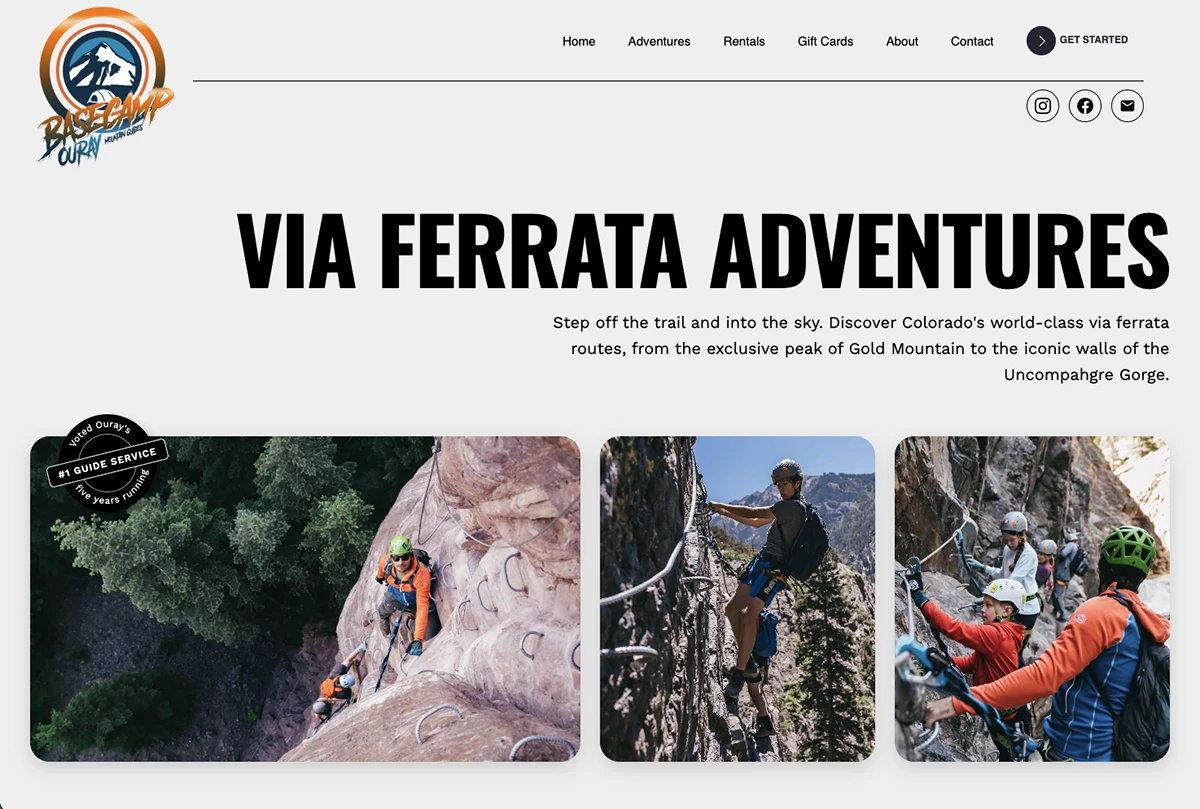
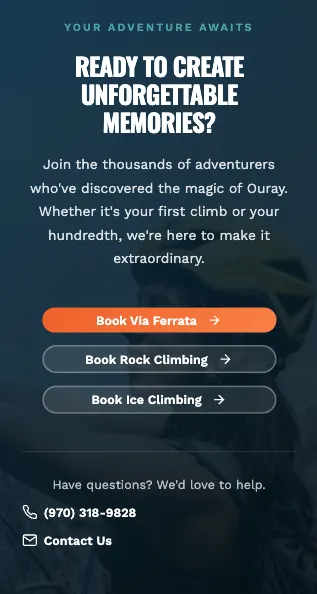
Ice climbing, rock climbing, via ferrata and corporate leadership trips each have their own page. Rentals, planning and the cancellation policy have theirs too.
Their booking system opens on each adventure page, so a traveler picks a date and pays without leaving the site.
Their 540 Google reviews sit on the homepage, in view before anyone reaches a trip.
Their via ferrata page shows on page one of Google for that search, one of the Ouray searches in the table above.
Ahrefs Site Explorer, US, October 2026: position 4.
Someone reading your trip page the night before is nearly booked. What stops them is one question the page doesn't answer. They mean to call you in the morning, and by then they've booked something else.
What travelers ask before they pay
Every trip page answers these beside the booking button, not three clicks away on a page of small print.
The booking system you already use opens right on the trip page. Nobody gets sent off to another site to pay.
Someone booking a trip for a partner or a parent finds your gift cards, from that same booking system, a tap away.
No WordPress plugins or page builder to patch. A trip page full of photos still loads on a phone at the trailhead.
No discount boxes, no newsletter sign-ups sliding over the price. The trip and the button stay in view.
Bullfinch is two people, and we do the work ourselves. There's no account manager passing messages along and no team you never meet. You'll work with both of us from the first week to launch.
Designs and builds your site
Kyle designs and builds every site we make, and he's the one you'll talk to on the intro call. He's been making websites since he was 14.

Runs the project and the schedule
Katie runs your project once it starts: what's due, from whom, and by when. She looks after more than 30 active clients and keeps every one of their projects on schedule.
about 60 days for a typical site
It all happens remotely, on Google Meet and a preview link, so nobody needs you off the water or off the trail. Start in your slow months and the new site is live before the season.
A 30-minute call with Kyle
On Google Meet, about your trips and the ones you most want to sell more of.
Your part Half an hour, from wherever you are.
A written quote within a week
A fixed scope and a fixed price, on paper, before anything starts.
Your part Read it and decide.
You send what you already have
Katie lets you know what's needed and when, and keeps track of it from there.
Your part Your trip list, prices, photos and policies, plus your booking system login or links.
We write every page
Every trip page, the homepage, the policies. You don't write a word of it.
Your part Answer our questions about your trips.
You review it on a preview link
The site as it's built, on a private link that opens on your phone.
Your part Look it over between trips and tell us what to change.
Launch
The site goes live with your booking system on every trip page.
Your part Send travelers to your own site.
It's usually the first thing an owner wants to know, so here it is up front. Where a site lands in our range depends on how much there is to build, and in tour operator website design that mostly comes down to your trips.
Most sites we build
$5,000 to $40,000
You pay for the build. There's no monthly plan to sign up for and nothing to cancel later.
Within a week of our call, a written quote sets out exactly what we'll build and what it costs. Nobody bills you by the hour.
The domain, the code and the hosting accounts belong to you. If you ever want another developer to take over, it all goes with you.
We can host the site and keep it updated, or hand it over clean. You edit trip descriptions and photos yourself; prices and dates stay in your booking system.
Short answers on where tourism website design meets what you already have: your booking system, your Viator listings, your current site and the Google searches it shows up for.
Something else on your mind? Bring it to the call.
Yes. Your booking system's checkout or booking buttons go right on each trip page, so a traveler picks a date and pays without leaving your site. Basecamp Ouray's runs on Xola, and we'll confirm yours on the call.
No. Viator and GetYourGuide put you in front of travelers who'd never find you otherwise, so keep your listings. Your own site is for the people who search Google for your trip or look you up by name.
Yes. The domain, the code and the hosting are yours, and nothing ties you to us. Move it to another host or hand it to another developer whenever you like.
Yes. We set you up with a simple editor for trip descriptions, photos and the rest of your words. Prices and dates stay where they are now, in your booking system, so you only ever change them in one place.
We plan the move around it. The pages worth keeping come over, and every old address redirects to its new page, so Google and anyone with an old link still land in the right place.
Yes, one: Basecamp Ouray, a guide service in Ouray, Colorado. We built it in three weeks, start to finish, and you can read how in our Basecamp Ouray case study.
Not to start. Every site we build is made for Google from day one: a page for each trip, quick on a phone, built the way Google's own guidance asks. Ongoing SEO or Google Ads are there if you want them, now or later.
Tell Kyle which trips you want to sell more of. He'll say what we'd build around them and roughly what it takes, and the fixed price follows in writing within a week.
Loading availability
Days with open slots
No openings
We're booked solid for the next 30 days. Drop us a line and we'll find a time outside the window.
Calendar invite is on its way to your inbox. Hit reply if anything changes.
Why talk before you're busy
Your slow months are the time for tour operator website design. A typical site takes about 60 days, so a start in the quiet stretch has it live before the next season. From then on, every trip it books is one you don't pay a booking site's commission on.
Want to see how we build for any kind of business first? Our web design service page covers it.