
For builders, remodelers and trades
Contractor website design that brings in the right jobs
We do contractor website design so more estimate requests come in for the jobs you want, from the towns you work in, with enough on each one to price it before you call back.
A fixed price in writing before anything starts.
Contractor web design: where the calls come from
People search for the work they need, then the town
A homeowner with a cracked foundation doesn't look up your company name. They type the job, then add "near me" or the name of their town. Here is roughly how often that happens.
Across the US
Searches a month
- foundation repair near me 42,000
- bathroom remodel near me 24,000
- general contractor near me 10,000
- deck builder near me 6,100
In one city: Denver
Searches a month
- bathroom remodel denver 500
- general contractor denver 400
- foundation repair denver 300
- deck builder denver 250
Source: Ahrefs, a search-data tool. These are its estimates of monthly US searches, October 2026, so read them as a rough size, not an exact count.
Smaller numbers, but the town is right there in the search.
What we build from this
We give each job you'd like more of, and each town you'll drive to for it, its own page from day one. Each one loads quickly on a phone and carries a clear title saying which job or town it covers. A search for the job and the town then has a page on your site that answers both.
Towns you'd rather not drive to don't get one.
The estimate request
A request you can price before you call back
A bare contact form hands you a phone number and "Need a quote, call me." The request on your new site asks one short question at a time, so it shows up with the town, the service, a few words about the job and photos.
Before: a plain contact form
Message from your website
"Need a quote, call me."
(303) 555-0142
- Where is it?
- What's the job?
- How big?
You find out on the callback, sometimes after the drive.
After: one question per step
New estimate request
Ready to price
-
Who's asking
Homeowner
Phone and email
Tells you who to call back
-
Where
Denver, CO 80210
Street address included
Tells you if it's a town you work in
-
Service
Deck repair
Tells you if it's work you want
-
The job
Two stair boards are soft and the railing wobbles. Deck is about 12 by 16, off the back door.
3 photosTells you how big it is and what to bring
Short steps get finished more often than one long form. And because each request says where, what and how big, you can tell which ones are worth the drive before you pick up the phone.
Stratalock's estimate form works this way, in four steps
Stratalock repairs foundations and stabilizes soil, and we built their site. Their live form asks who you are, where the job is, which service, then the job itself, with photos if you have them. These are its four screens.
-
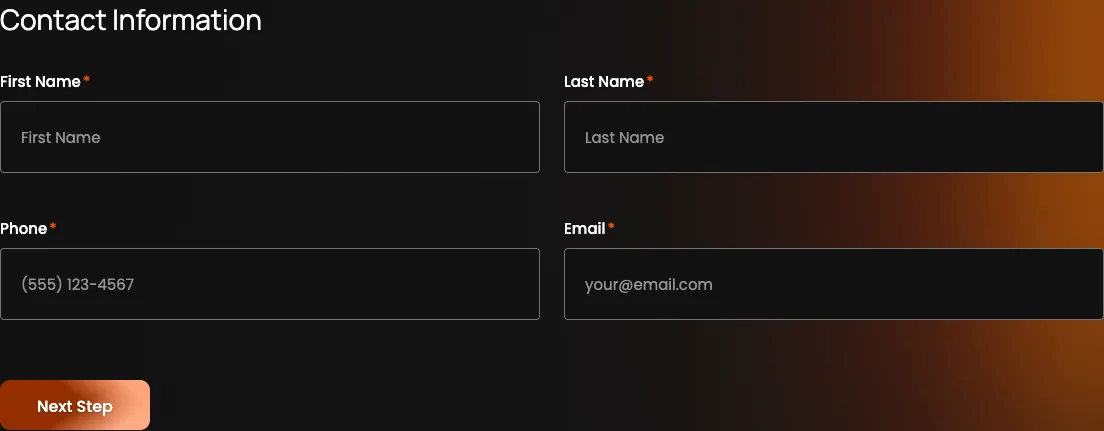
Step 1 of 4 Contact information
-
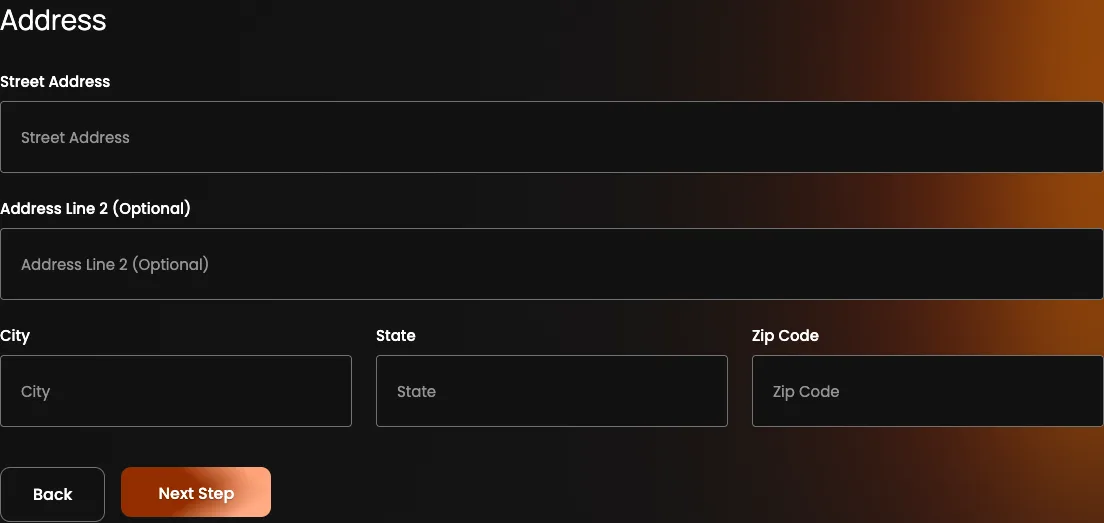
Step 2 of 4 Address
-
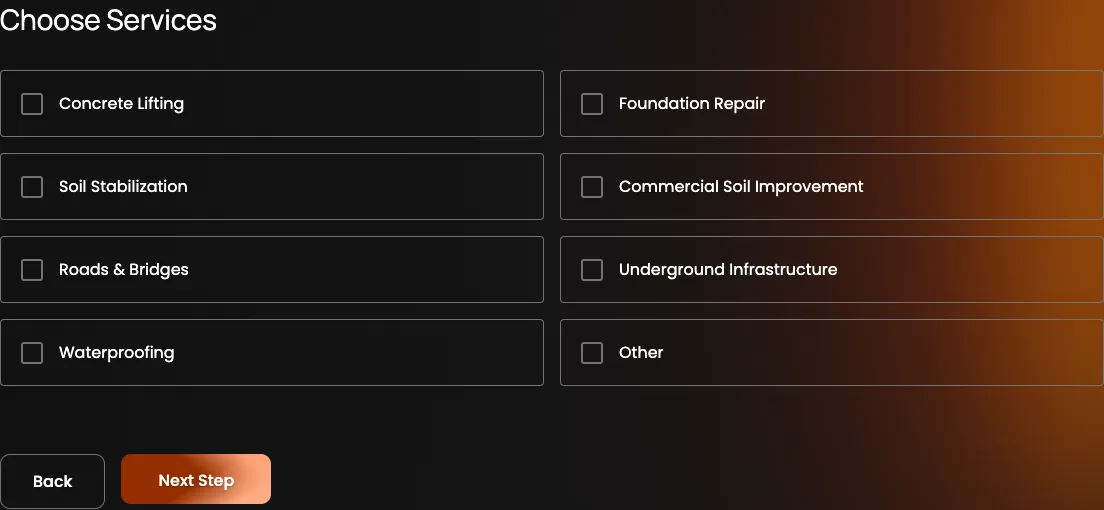
Step 3 of 4 Choose services
-
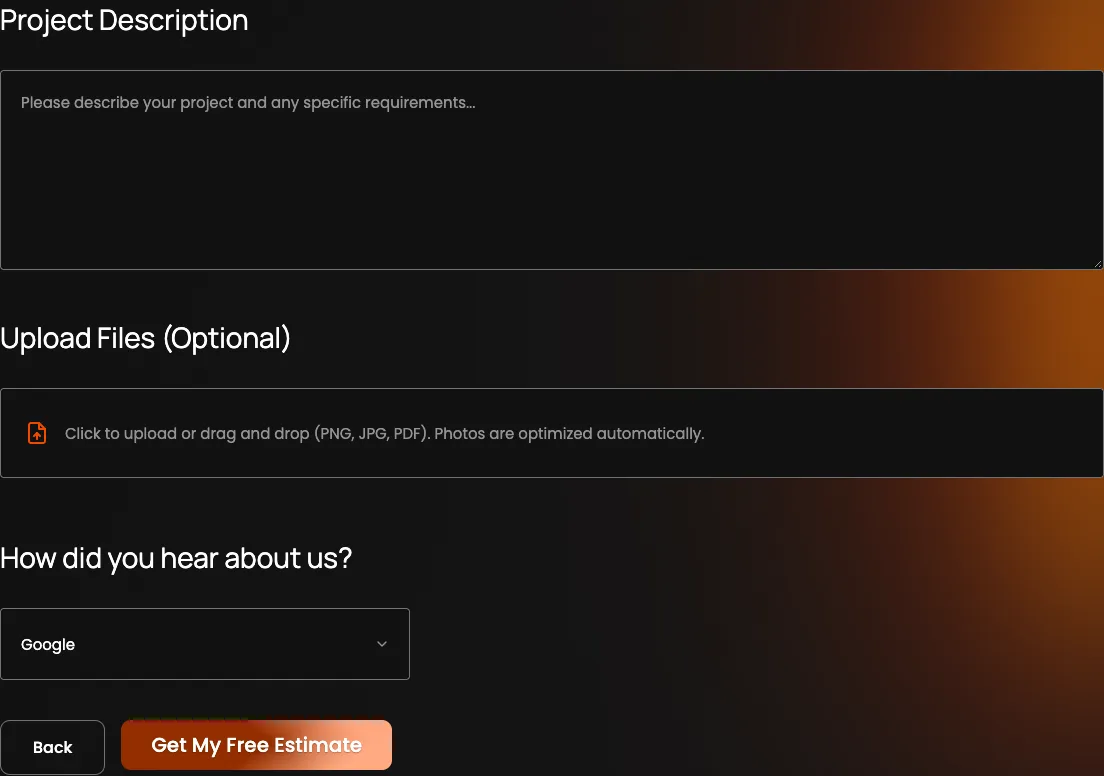
Step 4 of 4 The project, with photos
Screenshots of stratalockusa.com, October 2026. Swipe for all four.
Built for a foundation contractor
Stratalock's 27 pages, and why each one is there
Stratalock lifts and steadies settling foundations and slabs by pumping structural polymer into the weak ground under them, with no digging. Their customers are homeowners, owners of commercial buildings, and the crews behind infrastructure projects. Here is the site we built them, drawn as a map.
A page for each kind of customer, and one for each service
A homeowner and a city engineer don't read the same page. Each kind of customer gets a page written for them, and each service gets a page of its own to turn up in searches for that job.
Case studies
Every finished job is tagged with the town it was in and the work it took. The lines show where each one is filed.
City pages
One for each metro they want more work in, so a search with the city's name in it lands on a page about that city.
-
Residential
- Concrete Lifting
- Soil Stabilization
-
Commercial
- Stabilization and Lifting for Buildings
- Soil Improvement
-
Infrastructure
- Infrastructure Waterproofing
- Seawall & Waterfront Barriers
- Sinking patio Chicago, IL Filed under Concrete Lifting and the Chicago page.
- Settling 1950s home Denver, CO Filed under Soil Stabilization and the Denver page.
- Cracked swimming pool Kansas City, MO Filed under Soil Stabilization and the Kansas City page.
- Office floor Overland Park, KS Filed under Stabilization and Lifting for Buildings and the Kansas City page.
- Apartment footing Phoenix, AZ Filed under Stabilization and Lifting for Buildings and the Phoenix page.
- Cabinet shop floor Phoenix, AZ Filed under Stabilization and Lifting for Buildings and the Phoenix page.
- Construction company office Chandler, AZ Filed under Stabilization and Lifting for Buildings and the Phoenix page.
- Warehouse floor Ellettsville, IN Filed under Stabilization and Lifting for Buildings.
- Chicago
- Denver
- Kansas City
- Phoenix
Add the homepage, About, Process, Contact and the usual pages every business site has: 27 in all.
Work a few towns with a smaller crew? Your site follows the same pattern with fewer pages: a page per service, a page per town you take jobs in, and your finished work.
The Indiana warehouse job is outside their four cities, so it's filed by service only. Point at any job or page to trace it.
Three of the 27, up close
-
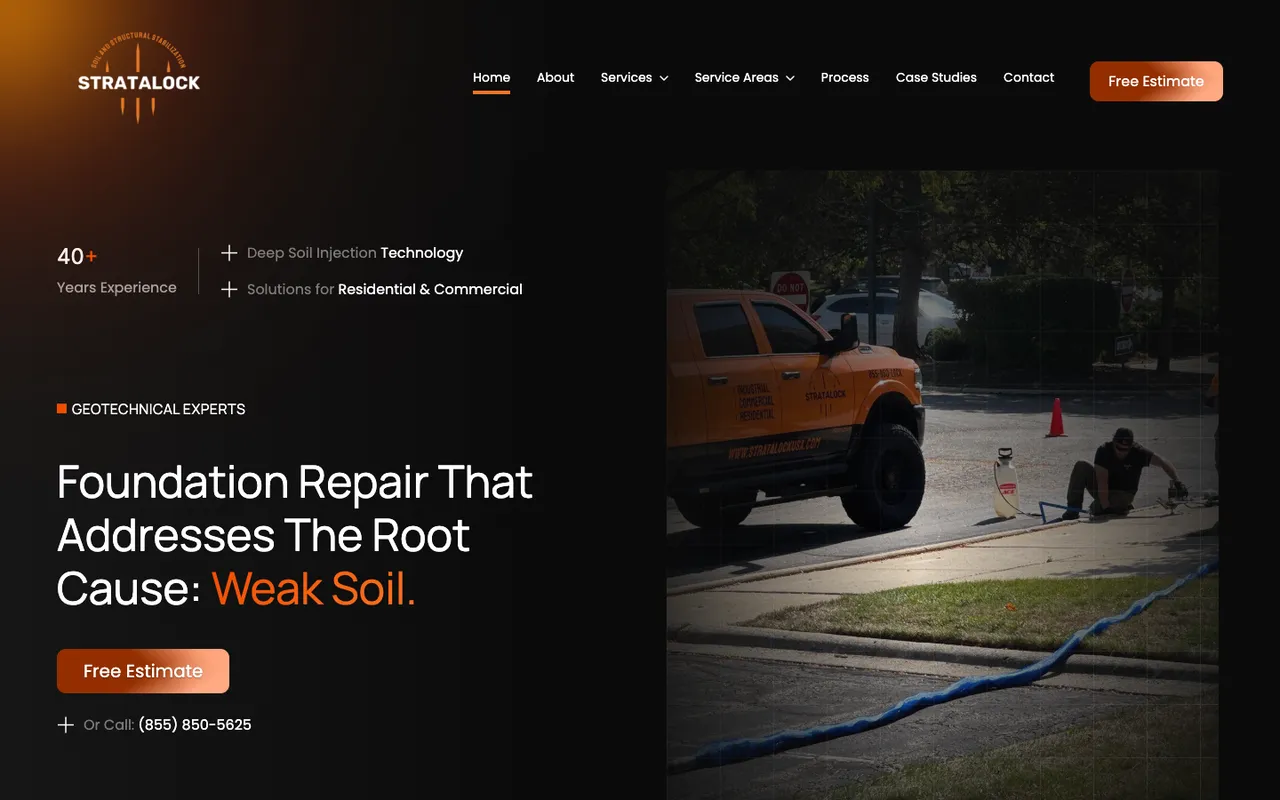
Homepage
For: Whoever arrives cold
One headline says what they fix and how. The estimate button stays in the top corner of every page on the site.
-
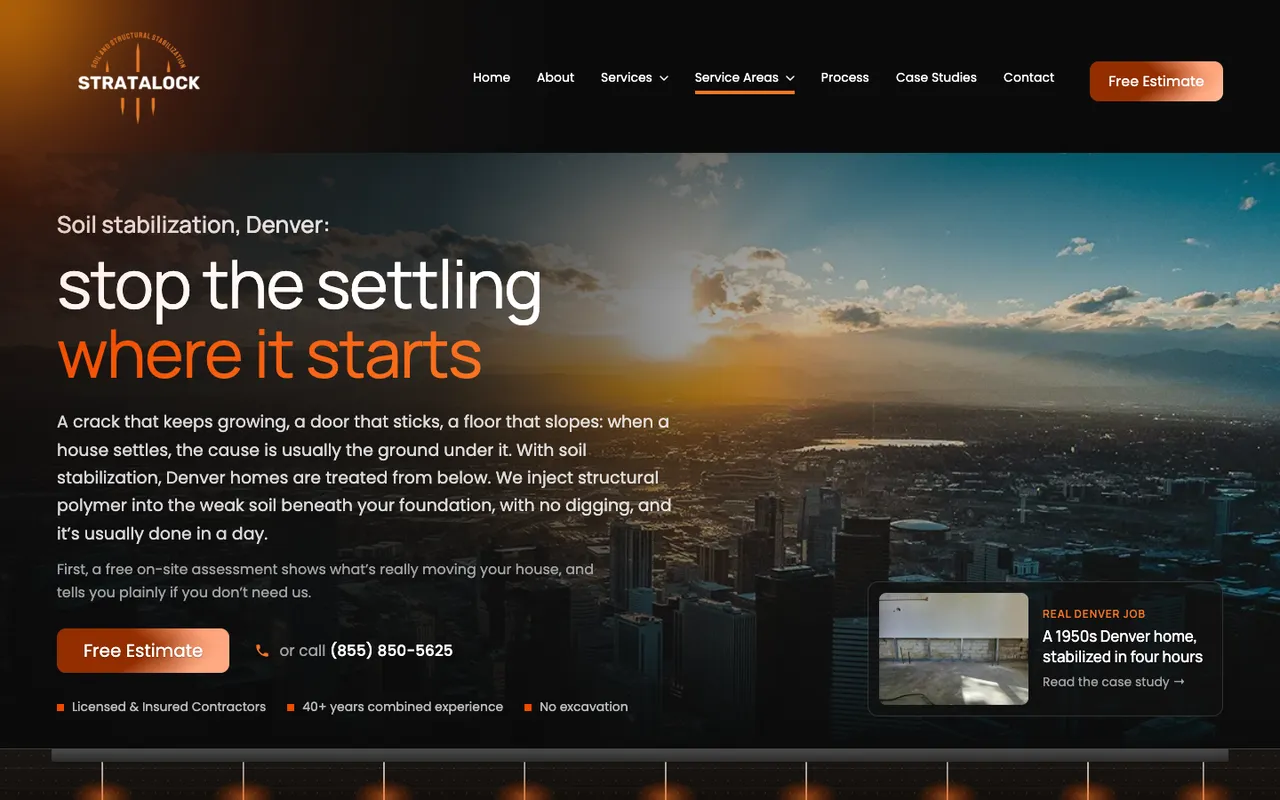
The Denver page
For: A homeowner who put the town in the search
Written for houses settling in Denver, with a real Denver job sitting right next to the estimate button.
-
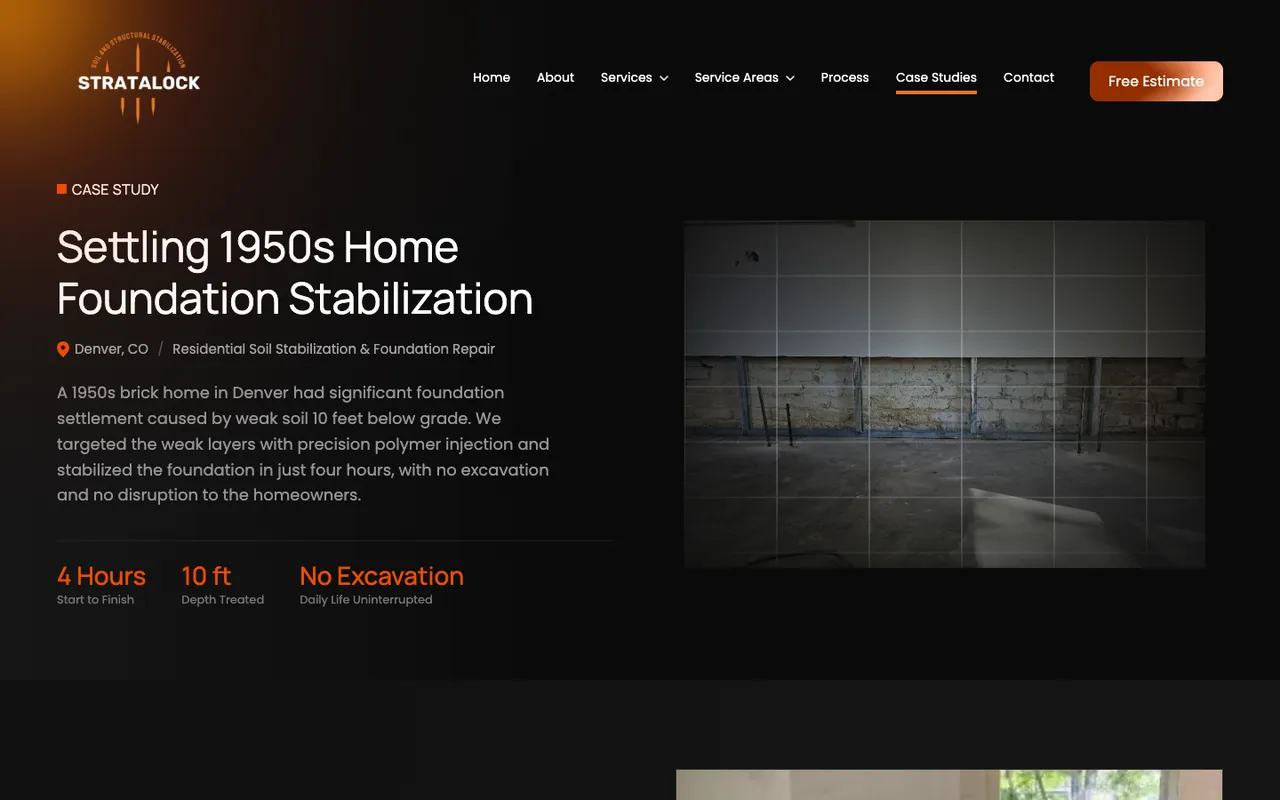
A Denver case study
For: Someone who wants to see it done nearby first
What was wrong, what the crew did and how long it took, tagged Denver and residential soil stabilization.
Screenshots of stratalockusa.com, October 2026. From any of these pages, the estimate button opens the four-step request in the section above.
After launch
When a job wraps up, Stratalock's team adds it themselves from an admin we built: the photos, the town, what was done. The site rebuilds with it, tagged by town and service just like the eight above.
We also built the site for Full Scope Metals, a shop that makes metal roof and wall panels and trim for roofers, builders and lumber yards. If you make the product rather than install it, see manufacturing website design. Running a trade in the Salt Lake Valley? See our web design in West Valley City.
Construction website design: the homeowner's four questions
What homeowners check before they call
Before anyone lets a crew onto their property, they look you up. They want four answers, and if any of them takes digging, the next contractor in the results is one tap away.
-
Are you licensed and insured?
In plain words right beside the estimate button, not tucked away on an About page, with the trade groups you belong to listed in the footer.
On Stratalock's site "Licensed & Insured Contractors" sits under the button on their Denver page, and the footer names groups like the American Society of Civil Engineers and the Deep Foundations Institute.
-
Have you done a job like mine, near me?
Your finished jobs, filed by service and by town. Someone reading your deck page sees decks you've built; someone on a town's page sees the work you've done there. It's the same filing as Stratalock's eight case studies above.
-
How does the estimate work?
A few straight lines next to the request: whether you come out to look, whether it costs anything, and when they'll hear back. Written the way you already run estimates, so nobody is surprised on the callback.
-
Will this even load on my phone?
Your pages come up quickly on a homeowner's phone. Under the hood it runs on Astro, a newer and lighter way to make websites, so there's no WordPress, no plugin updates waiting on you between jobs, and nothing that stops working because nobody logged in all season. Astro is open-source and widely used, so any web developer can pick the site up later.
Why it pays
None of this is news to you. It's what you'd tell a homeowner on a site visit anyway. Put where they look, it turns someone checking you out into an estimate request, not a call to the next name on the list.
How the project runs
Your part: one call and the job photos on your phone
You're on job sites all day, so the project is set up around that. You talk, we write. You send photos you've already taken, we turn them into pages. Here is every step, and what each one asks of you.

Contractor website design, step by step
-
A 30-minute call
What work you want more of, which towns you want it in, and what you'd rather pass on. It's on Google Meet, so a truck cab works fine.
From you: 30 minutes, booked from this page
-
A fixed price in writing, within a week
The whole scope and one price for it, before any work starts. If the number doesn't make sense for your business, you say no and that's it.
From you: A yes or a no
-
We write the pages
Every service page and town page, written from what you told us on the call. You send the job photos already on your phone, and we choose them and put each one where it does the most work.
From you: The photos you already have
-
You see the design on a preview link
A real link that opens on your phone, before anything is public. Tell us what looks off and we change it.
From you: A look, and your notes
-
We build a site that loads fast and needs little upkeep
It's built on Astro, a modern tool for making fast websites, so pages open quickly on a homeowner's phone. Nothing for you to install, and no plugins or updates to babysit.
From you: Nothing
-
It goes live
Usually about 60 days from kickoff.
From you: Nothing
-
Once it's live
You add finished jobs yourself
From a simple admin: the photos, the town, what you did. Each job shows up on the matching service and town pages, without a call to anyone.
From you: Whenever a job wraps up
Add it up
One call, a yes, a look at a preview link and photos you already took. Everything else is our work, and nobody asks you to run a project between site visits.
The price, before the call
What a contractor website costs
Here's the number up front, so you can weigh it against what a few good jobs bring in and decide whether a half-hour call is worth it.
Most sites we build
$5,000 to $40,000
Your price is one fixed number for the whole scope, and it reaches you in writing inside a week of our call. There's no hourly meter running while we write and build.
How we price, write and build each site is set out on our web design page.
We price general contractor website design the way you bid a job: on three things
-
How many services and towns need pages
Each service you're after and each town you'd drive to earns a page of its own, written for that job in that place. A deck builder covering a handful of towns needs fewer pages than a builder taking every kind of job across a metro.
-
How many past jobs come across
The finished jobs we bring onto the site for launch, each with its photos, its town and what your crew did. Once the site is live, new ones are yours to add.
-
What the estimate request and the admin need to do
A request that asks where, what and how big, with room for photos, is where it starts. Each extra question it asks, and each extra thing you want to manage from the admin yourself, is more to build.
Ownership and upkeep
The whole site is yours
You own the domain, the site's code and every hosting account. If you ever switch hosts or hire another developer, you take the site along.
After launch, your call
We can keep looking after the hosting and updates, or hand it all over to you clean, with nothing held back.
Who you'd deal with
Two people build it, and Kyle takes your call
Bullfinch is Kyle and Katie Rutten, and that's the whole company. Nobody in sales books your call, and no account manager relays your notes to a designer working out of sight.
-

On your 30-minute call
Kyle Rutten
Designs and builds every site
Kyle hosts the call. He asks about the work you want more of and the towns you'll drive to, then he designs the pages and builds the site himself. Nothing you tell him gets passed along to someone else.
-

From the written price to launch
Katie Rutten
Runs operations and keeps your project on track
Katie runs every project, schedule and account. She keeps yours moving from the day you say yes to the day it goes live, so you're never the one chasing anybody for an update between site visits.
Nobody in the middle
You've had the calls from marketing companies and lead services. This is two people with their names on the work. You book a time, Kyle is on the other end, and the person who hears about your jobs is the person who builds the pages for them.
Short answers
Before you book: what contractors ask
The doubts that come up right before an owner picks a time, each answered in a line or two.
-
My jobs mostly come from referrals already. Do I really need a better website?
A referral still looks you up before calling, and your website is what they land on. When it shows the kind of work they heard about, the recommendation holds up and they call.
-
I'm on job sites all day. How much of my time does this take?
One 30-minute call and the job photos already on your phone. We write every page, and you check a preview link before anything goes live.
-
I've been burned by a lead service before. How is this different?
A request from your own website comes to you and nobody else. It isn't shared with other contractors, and there's no fee per lead.
-
Won't more requests just mean more tire-kickers and jobs too far away?
Your site only gets pages for the towns you want work in. Every request shows the address and the job up top, so a far-off or poor-fit one is easy to pass on.
-
Can I add my own job photos, and do I own the site?
Yes to both. You add finished jobs from a simple admin whenever one wraps up, and the site, its domain and its hosting accounts belong to you.
-
Do you only do website design for contractors?
No, we build for small businesses of all kinds. Stratalock, the foundation repair company above, is a contractor. Full Scope Metals sits on the supply side: it makes metal roofing and sells it to contractors.
-
Does contractor website design include SEO, or is that extra?
The groundwork comes with every site: its own page for each service and town, a title on each page naming the job and the place, headings Google can follow, and pages that don't keep a phone waiting. Ongoing search work after launch is optional, and that's what our SEO services are for.
The next step
Book 30 minutes before your next estimate
Pick a slot between site visits. Kyle runs the call on Google Meet, and by the end of it you'll know whether a new site makes sense for your business.
On the call, we go over
-
The jobs and towns you want more of
The kind of job you'd happily fill your calendar with, and how far you'll send a crew for it.
-
What your requests arrive with today
Whether a new inquiry gives you enough to price the job, or just a name and a number to chase down.
-
The pages you would need, and the price
Which service pages and town pages are worth building for your work, and what pushes the price up or down.
Within a week of the call
A fixed price in writing, one number covering the whole scope. Nothing starts unless you say yes to it.
Why book it now
A build usually runs about 60 days from kickoff. Book before your busy season and the new site is already live, taking estimate requests, by the time homeowners start calling around.