
Empty meeting room with a closed laptop and two coffee cups, a glass wall looking onto a warehouse of pallets

B2B web design that brings in new accounts

Before a company buys from you, someone there looks you up, usually more than once and usually with a colleague, and our B2B web design is built for that visit. The site turns up when they search for what you sell, answers their questions without a sales call, and makes asking for a quote or a conversation the obvious next step. You own all of it.

Book a call 30 minutes on Google Meet

$5,000 to $40,000, fixed in writing before we start 5.0 on Google

A B2B website should open accounts, not just describe the company

A business that buys from you rarely buys once. It reorders, renews and sends the next company your way, so one new account can be worth years of orders. That is the yardstick for B2B website design: not how new the site looks, but how many accounts it opens.

One new account

  1. The first order A trial run on one job or one shipment.
  2. The reorders Same specs, fewer questions, again and again.
  3. The renewal Another year on the books without a new pitch.
  4. The referral A company like them, calling on their word.

Think of what your best account has brought in since its first order. That is the number to measure a website against.

A site opens accounts two ways: more of the companies that land on it reach out, and more of them find it when they search for what you sell.

Most B2B sites do neither

  • About Us
  • Our Mission
  • Services
  • Contact Us

A page about the company, a mission statement, a list of services and a contact form at the bottom. The buyer can't tell whether you make what they need, for a company like theirs, or how ordering works, so they go back to the results and try the next name.

Every site we build does both from day one

1More of them reach out

Each page follows how a business buyer decides: what you sell, who it's for, the proof, how buying works, and the next step right beside it.

2More of them find you

Built to Google's own guidance for speed, phones and page structure, so your products and services can turn up when buyers search for them.

Sites we’ve built for companies that sell to businesses

Three companies we’ve done B2B web design for. A fabricator, a contractor and a service firm, each selling to a different kind of business, and each site built around how those buyers check a supplier out and ask for a price.

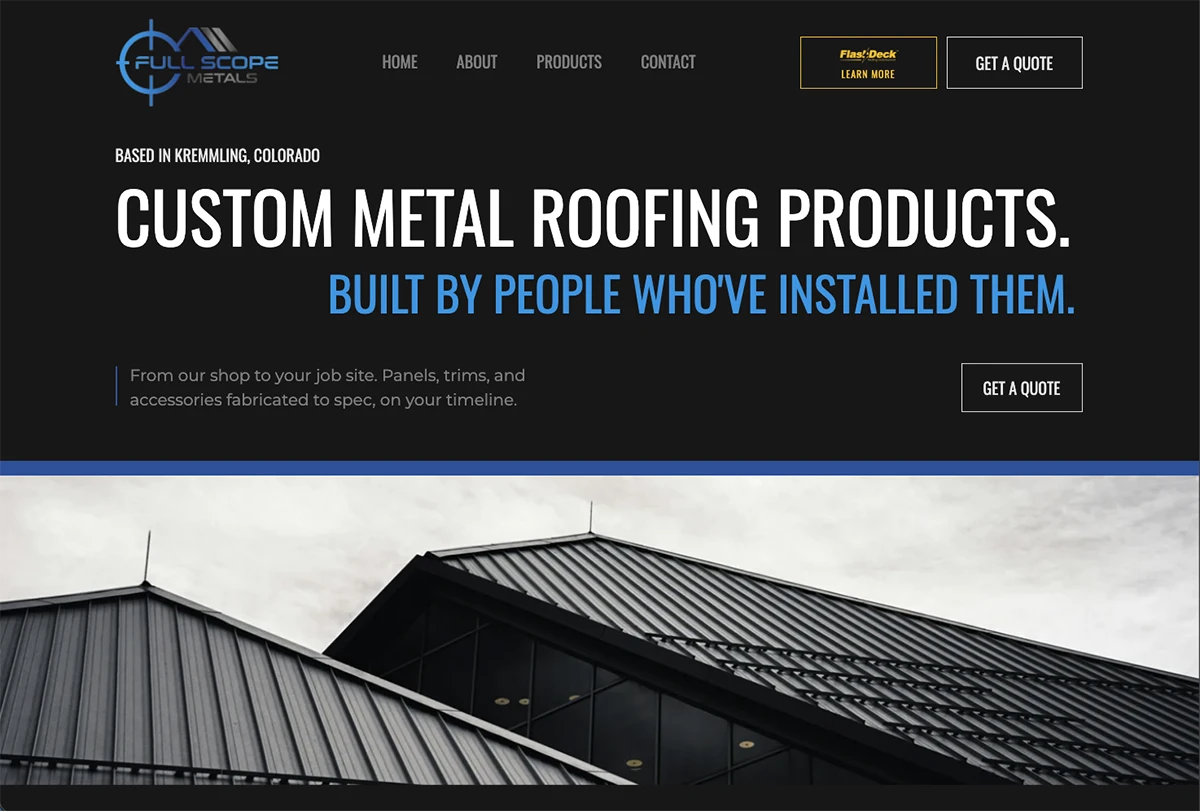
Full Scope Metals homepage: custom metal roofing products, a Get a Quote button and dark standing-seam roofs

Metal roofing fabricator · Kremmling, Colorado

Full Scope Metals

Sells
Roof panels, trims, fasteners and underlayments, made to spec
To
Roofing contractors, general contractors, lumber yards and property managers
  • Before writing a page, we asked contractors who order from them what they wish a supplier’s site told them.
  • Products sit in 7 categories, grouped the way a contractor reaches for them on a job.
  • Asking for a quote is the main thing the site invites, and every request reaches a person there.
See the Full Scope Metals case study
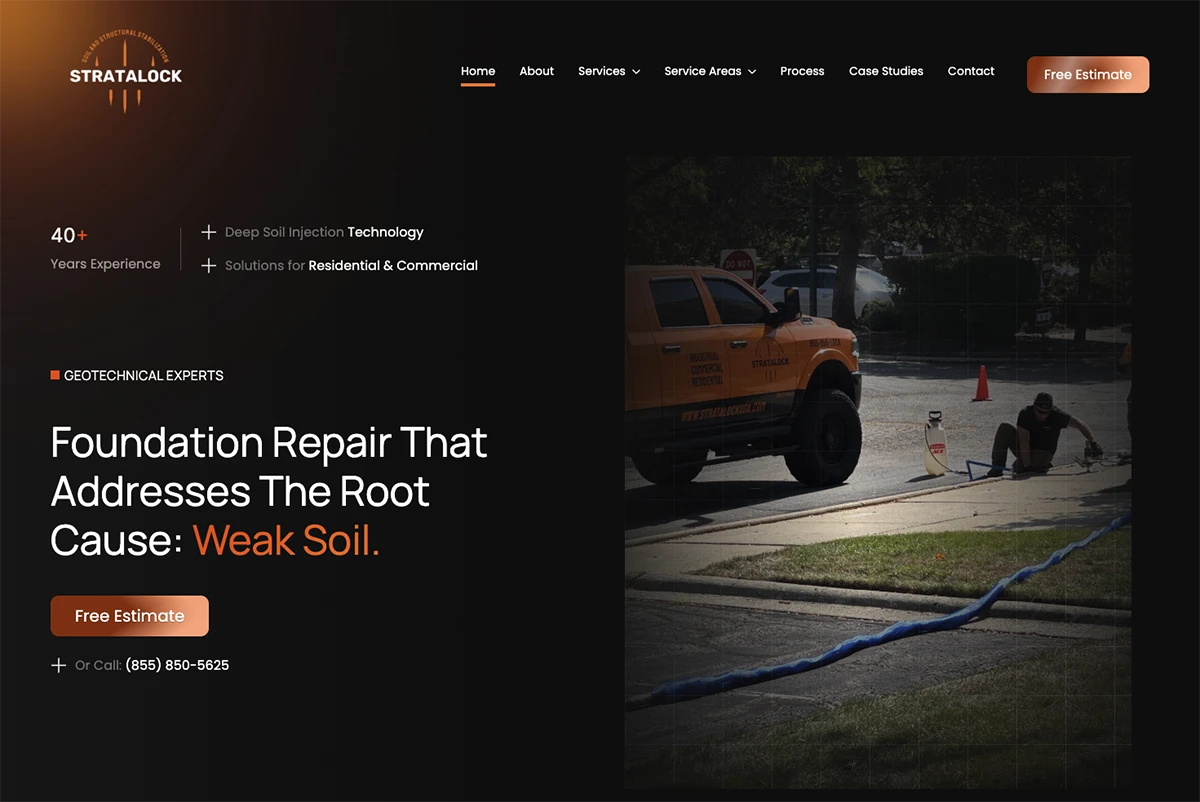
Stratalock homepage: foundation repair that addresses weak soil, over a crew injecting beside a slab

Foundation repair · three buyers

Stratalock USA

Sells
Deep polymer-injection foundation repair
To
Homeowners, commercial and industrial property owners, and infrastructure projects
  • Three buyers with little in common, so the homepage splits into a path for each: Residential, Commercial & Industrial, Infrastructure.
  • Case studies are sorted by sector, so each buyer lands on jobs like their own.
See the Stratalock case study
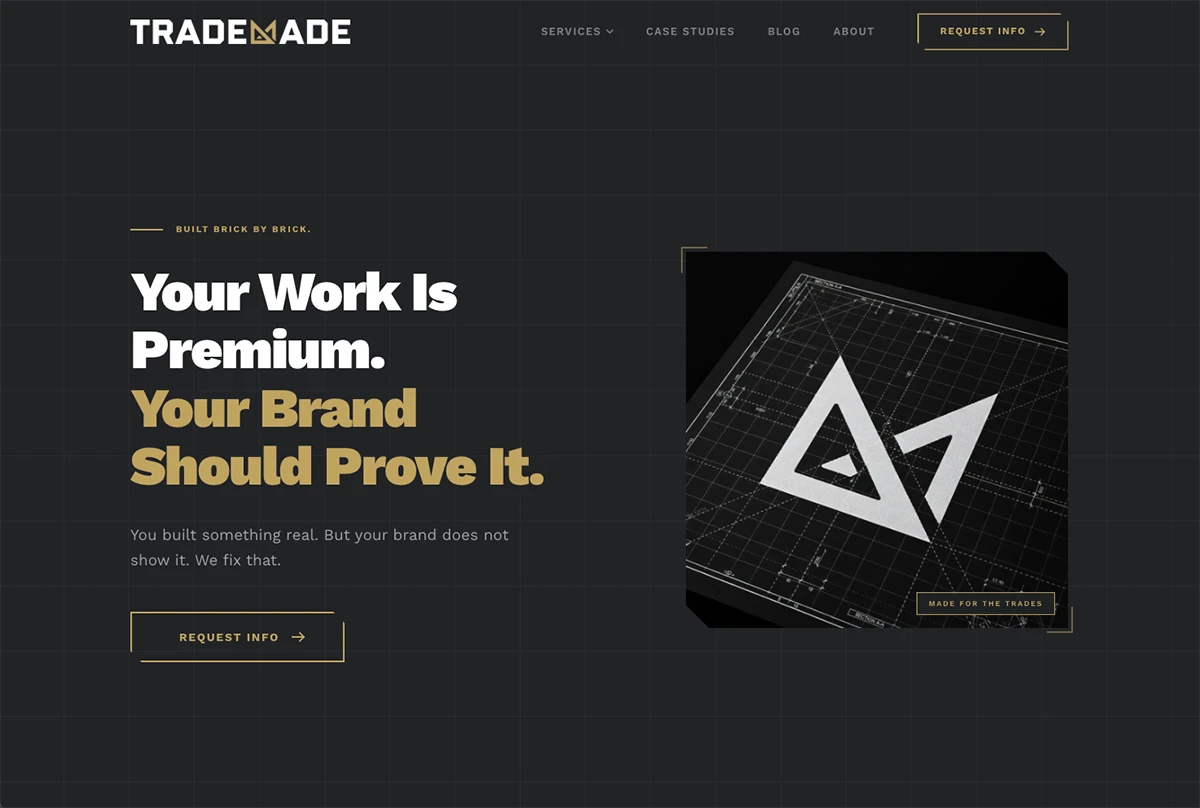
Trademade homepage: your work is premium, your brand should prove it, with a Request Info button

Brand agency · a service firm

Trademade

Sells
Brand work for contractors, across 8 services
To
Residential contractors: roofers, flooring crews, landscapers and custom-home builders
  • Each of the eight services has its own page, so a contractor can find the one they came for.
  • Real client work sits beside the services, so the buyer sees finished jobs next to what they’d be paying for.
See the Trademade case study

Your website sells between the calls

A company rarely decides on one visit. Someone hears about you from a rep, at a trade show or through a referral, and looks you up. They pass your link to the person who signs off. Someone else checks the specs or the terms. Weeks later, somebody comes back ready to ask for a price. Each of them arrives with one question, and nobody from your side is there to answer it.

  1. 01 · The first look

    A rep sends your link after the show

    They ask
    What do you do, and is it for companies like ours?
    The site shows
    What you sell and who you sell it to, on the first screen.
  2. 02 · The forward

    It lands with the person who signs off

    They ask
    Have they done this for anyone like us?
    The site shows
    Work for companies like theirs, sorted so they find their own industry.
  3. 03 · The detail

    Someone checks the fine print on a phone

    They ask
    Can they actually meet our spec?
    The site shows
    Specs, capabilities and process, easy to check on a small screen.
  4. 04 · The ask

    Weeks later, someone is ready for a quote

    They ask
    How does buying work, and who answers?
    The site shows
    Minimums, lead times, how quoting works, and a short form that reaches a person.

Four visits, four different people, and not one of them had you in the room. We build the site to make your case at every stop, so the company that finally reaches out already wants to talk.

A page for each kind of business you sell to

Nobody searches for your company’s name until they already know it. They search for the product, the service or the problem in front of them, often with their own industry in the words. A single “Solutions” page listing everything you do turns up for none of those searches, and when a hospital buyer and a contractor read the same general page, both leave sure it wasn’t written for them.

Every one of these pages has

  • What it is
  • Who it’s for
  • Proof from that kind of customer
  • The detail they check
  • A button to ask
A hospital’s facilities manager
/industries/healthcare/ What you supply for buildings that never close, work you’ve done for other hospitals, and who to ask.
A general contractor pricing a bid
/industries/contractors/ What you supply for their kind of build, jobs like theirs, lead times, and a quote request beside it.
A distributor looking for a new line
/industries/distributors/ Minimums, how reorders work, other distributors who carry you, and how to open an account.
An engineer checking one product
/products/custom-brackets/ Sizes, materials, tolerances and capabilities, parts made for others, and a way to ask for a price.
A property manager with buildings to look after
/services/maintenance-contracts/ What the service covers, buildings like theirs you already maintain, how scheduling works, and someone to call.

These pages are most of the real work in B2B website development, and they’re how a company that has never heard of you finds you. If you make what you sell, here’s how we build websites for manufacturers.

When they’re ready to talk, make it one easy step

Business buyers don’t add to cart. When they’re ready, they ask: for a quote, for pricing, for a sample, or for someone to talk to. Your site offers the ask that fits how you sell, right on the pages where they make up their mind, and keeps it to one short step.

  1. 01 · Their side

    The ask that fits how you sell

    A quote for made-to-order work, pricing for a standard line, a sample before a big order, a conversation for a service. It sits beside the specs on every product and industry page, not only behind a Contact link.

  2. 02 · Your side

    Only what your team needs to reply

    Name, company, email, what they need, quantity and timing. Enough for whoever prices the job to answer properly the first time, short enough that a busy buyer finishes it, and it goes straight to that person.

  3. 03 · The wait

    They know when they’ll hear back

    The moment they send it, the buyer gets a note saying when to expect your reply, so they aren’t left wondering, or sending the same request to the next supplier on their list.

Nothing extra loads, quick on a phone

Fast where your buyers actually are

We build in Astro, which sends each page out plain and finished: no WordPress plugins, no theme, no page builder piled on top. Your product pages, photos and the request form open quickly on a phone at a job site or a laptop on a crowded office network, and Google reads them without trouble.

Who builds it, and the little it asks of you

Bullfinch is a B2B web design agency of exactly two people, and the two of us do the work. No account manager in the middle, no junior you meet halfway through. Here’s who you’d be dealing with.

Kyle Rutten, web designer, working at a laptop in a bright brick-walled studio

Kyle Rutten

Designs and builds your site

Kyle built his first website at 14 and has been at it ever since. He designs every page and writes the code behind it himself, and he’s the one you talk to on the first call.

Katie Rutten, project lead, at a laptop in a bright brick-walled studio

Katie Rutten

Runs the project and the schedule

Katie keeps every date and every next step on track. Thirty-plus active clients, every project on schedule, and you won’t be chasing anyone for an update.

What it asks of you, from call to launch

You don’t need a marketing person or a writer. Your part is one call, a folder of files you already have, an introduction to whoever sells, and reading what we write.

  1. The call

    YouThirty minutes on Google Meet about the customers you want more of.

    UsAsk how your deals usually start and who signs off.

  2. Within a week

    YouRead the quote and decide.

    UsSend a written quote with the scope and the price fixed.

  3. Your files

    YouSend what you already have: the sales deck, line card, spec sheets, and the questions prospects always ask.

    UsRead all of it before we write a word.

  4. One conversation

    YouPut us on a call with whoever does the selling.

    UsWrite every page from that talk and your files, in the words your buyers use.

  5. Preview link

    YouClick through the site, mark what’s wrong, approve each page.

    UsMake the changes until it reads right to you.

  6. About 60 days

    YouSay go.

    UsLaunch it, and point your old addresses to the new pages.

All of it happens on Google Meet and a preview link, so it fits around your week.

Book a call

What a B2B website costs

Most sites we build land between $5,000 and $40,000. The build is quoted once, as a fixed price in writing, not a monthly plan for the site. In B2B web design, where yours lands comes down to how much your buyers need to see, how they ask to buy, and whether you add ongoing SEO or Google Ads, an optional extra quoted with the build.

Most sites we build

$5,000 $40,000

What moves it

  • How many pages

    Nearer $5,000: A few pages on what you sell and who it’s for

    Nearer $40,000: A page for every product, service and industry you sell into

  • A catalog or spec sheets

    Nearer $5,000: Products described on the pages that sell them

    Nearer $40,000: A full product catalog, or a library of spec sheets to download

  • How buyers can ask

    Nearer $5,000: One request form that lands in one inbox

    Nearer $40,000: Quote, sample and call requests, each going to the person who handles it

  • Optional: help finding buyers

    Nearer $5,000: The site on its own

    Nearer $40,000: The site plus ongoing SEO or Google Ads, if you choose them

  • One price, in writing

    The scope and the price are fixed in a written quote, usually within a week of the call. No hourly meter running, and no invoice you didn’t see coming.

  • Yours, not rented

    The domain, the code and the hosting accounts are in your name. Your team edits products, pages and specs in a simple editor, and you can take the site to any developer you like.

  • After launch, your call

    We can host it and keep it updated, with SEO or Google Ads if you want them. Or we hand the site over clean and you run it from there.

Tell us what you sell and who buys it, and you’ll know where your site lands. Book a call

Questions B2B companies ask before they book

Short answers to what owners and sales leads ask us most. Anything we haven’t covered, ask Kyle on the call.

Book a call
  1. Most of our business comes from reps, referrals and trade shows. Does the website matter?

    Yes, because that is exactly when people look you up. After a rep’s call, a referral or a trade show, the buyer checks your site before they reply, and so does whoever they forward it to. A good site backs up what your rep said. A thin one loses the deal quietly, and nobody tells you why.

  2. Do you know our industry, or will we spend months teaching you?

    We’ve built sites for a custom metal roofing fabricator, a foundation-repair company that sells to commercial and industrial property owners, and a brand agency that serves contractors. We learn the rest of your business from the files you already have and one conversation with your sales team. You approve every page before it goes live.

  3. Do we own the website?

    Yes, all of it. The domain, the code and the hosting accounts are yours, so nothing ties you to us if you ever want to move it.

  4. Can our own team update products and pages?

    Yes. Your team changes text, prices, photos and spec details in a simple editor we set up for you, so a new product or a changed lead time never has to wait on us.

  5. Will we lose what our current site ranks for on Google?

    We take care that you don’t. We carry over the pages worth keeping and redirect every old address to its new page, so the searches and links that find you today still land somewhere useful.

  6. Do we need SEO or ads on top of the website?

    Not to start. As a B2B website design agency, we give every site, from day one, a page for each product, service line and industry you sell into, written in the words your buyers search. Each page loads fast, works on a phone and is set up so Google can tell what it covers. Ongoing SEO or Google Ads add reach, only if you want them.

Book 30 minutes about your B2B website

A plain conversation on Google Meet with Kyle about B2B web design for your company. Here is what the half hour covers.

  1. You talk. Who you sell to, and which customers you want more of.

  2. We answer. What we’d build for those buyers, and roughly what it takes.

  3. Then it’s on paper. Your fixed quote arrives in writing within a week.

Why not next quarter

A new site takes about 60 days to build. Until it’s live, every company that looks you up after a rep’s call or a referral is making up its mind from the site you have today.

Rather pick up the phone? 720-299-8584 5.0 on Google

Not only selling to businesses? See how we build websites for every kind of company.

Pick a day and time

Loading availability