



An empty therapy room in morning light, two armchairs facing each other beside a window

For private and group practices

Therapist website design that fills your caseload

Our therapist website design starts where your clients do: with the kind of help they need. They find your practice on Google for it, then see who they'd be talking to, what it costs and how to take the first step.

The price is fixed and in writing before a single page is built.

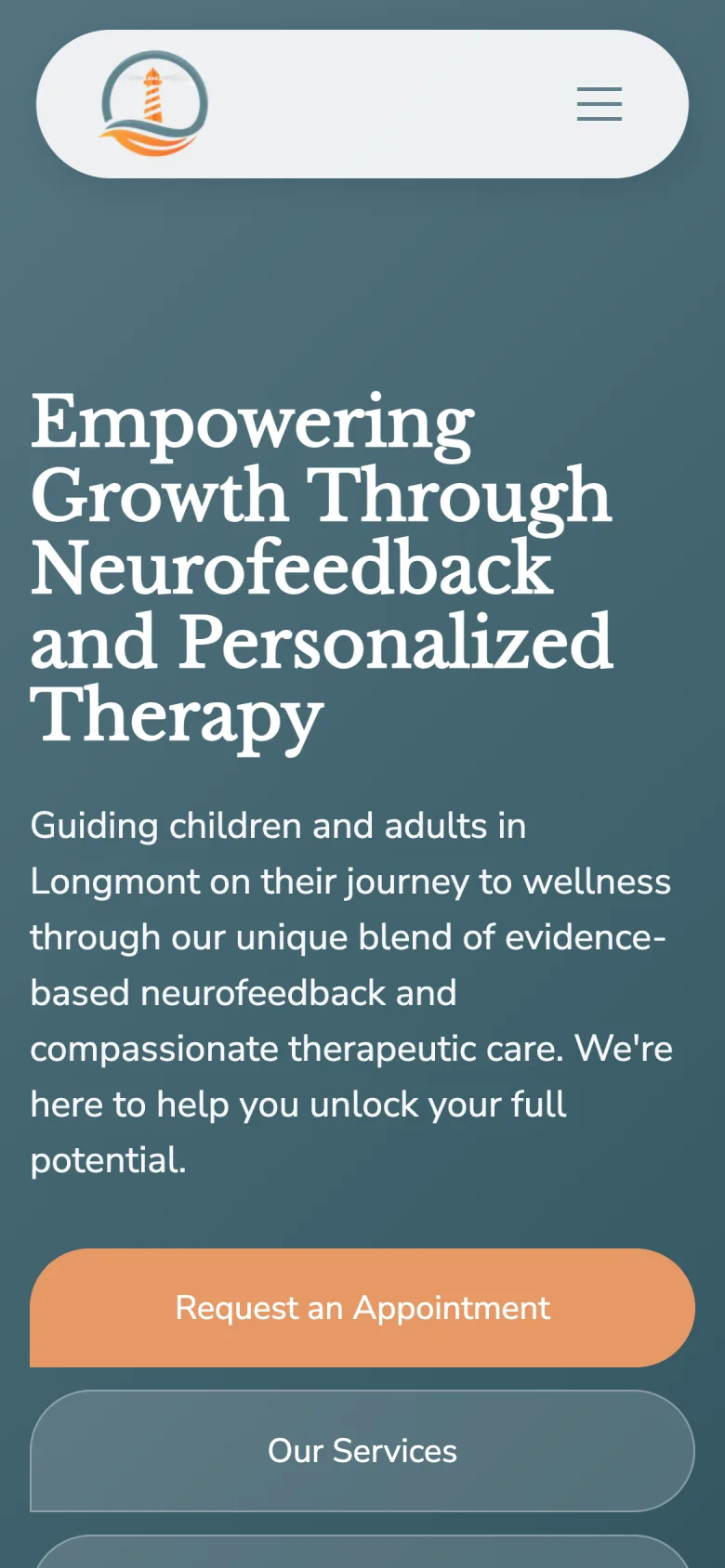
Lighthouse's homepage on a phone: its headline, a short welcome and a Request an Appointment button
A practice site we built Lighthouse Neurofeedback and Behavioral Health, Colorado

How clients find a therapist

People look for the kind of help first, then the person

The words people put in the search box name the kind of help they need, and often who it's for. A clinician's name comes later, once there are a few to choose between. Psychology Today appears in those results. A practice's own pages can appear right beside it.

Searches a month in the US

Estimated by Ahrefs, which tracks what people search, October 2026

therapist near me 217,000

Then the kind of help, by name

  • child therapist near me 14,000
  • anxiety therapist near me 5,200
  • trauma therapist near me 4,300
  • couples therapist near me 3,200
  • family therapist near me 2,600
  • EMDR therapist near me 1,900
  • neurofeedback near me 1,400

Page one of Google for “therapist denver”

Recorded by Ahrefs, which tracks Google's results

Denver is here as one example: a single city search we checked in October 2026.

  1. #1 Google's map of nearby practices
  2. #2 Psychology Today, a directory
  3. #3 Google's “People also ask” box
  4. #4 A small practice's own site
  5. #5 A small practice's own site
  6. #6 A small practice's own site
  7. #7 Mental Health Match, a directory
  8. #8 A small practice's own site
  9. #9 TherapyDen, a directory
  10. #10 A small practice's own site

Directories take three of the spots. Small practices with sites of their own take five.

Therapist web design that starts with the search

So we give each kind of help you offer its own page, and say who it's for: adults with anxiety, children, couples, families, EMDR. Each one is built to the guidance Google publishes for site owners: fast loading, clean structure, proper titles. That lets it sit next to your Psychology Today profile rather than replace it.

One more client a week

$120 a session × 52 weeks about $6,240 a year

$120 is the psychotherapy session rate Lighthouse publishes on its site. This is arithmetic on that rate, not a forecast of what a website will bring in.

Before anyone reaches out

Clients choose a person before they choose a practice

Once someone has found the kind of help they need, one question is left: who would I be sitting across from? They want a face, a name, the right training and a sense of how that person talks. A list of names on a team page can't tell them that. A page for each clinician can, and it gives them one plain way to take the first step.

Your photo

Your name, MA, LPC

She/her

Sees

Adults and teens, for anxiety, grief and big life changes

How I work

Plain conversation, a pace we set together, and something practical to carry into your week.

Office

Main Street office, Tuesdays to Thursdays

Request a first appointment

Asks for a name, a way to reach you and the kind of help you're looking for. Nothing clinical.

A drawing of one clinician's page. Every word on it is a stand-in for yours.
  1. Name and credentials

    Who is licensed to help, and with what training, in the first line they read.

  2. Pronouns

    Said up front, so nobody has to wonder or ask.

  3. Who they see

    Ages and concerns named plainly, so the right people recognize themselves.

  4. How they work, in plain words

    What sitting with this person is like, written without the clinical vocabulary.

  5. Which office

    Where and on which days, so the drive or the schedule never becomes the reason to wait.

  6. One next step

    A single button and a short request: a name, a way to reach you, the kind of help.

Every clinician on your team gets a page like this, and every page ends the same way: one next step, and a request short enough to send at the end of a hard day.

Already live at Lighthouse

44 pages like this, one for each person on the team

Lighthouse Neurofeedback and Behavioral Health has clinics in Longmont and Westminster, Colorado. Each person there has a page with their credentials, pronouns, role, clinic and a bio. The team page lets people filter by the kind of help, from ABA and neurofeedback to play therapy and couples work, and Request an Appointment sits in the header of every page.

Screenshot of a clinician's page on Lighthouse's site, with name, credentials and pronouns as the heading and role beneath
Lighthouse, one person's page. Credentials and pronouns are the heading itself, and the role sits right under the name.
Screenshot of Lighthouse's Meet Our Staff page: a card per person with photo, name, credentials, pronouns, role and clinic
Lighthouse, the team page. A card for each person, with credentials, pronouns, role and clinic, and each card opens that person's own page.

One visit, in order

A practice site we built, the way a client walks through it

Lighthouse sees clients at its clinics in Longmont and Westminster, Colorado, and offers ABA, neurofeedback, psychotherapy, and family and couples therapy, to adults and to children. Here is the site we made for it, in the order a new client meets it: from the first page they open to the moment they ask for an appointment.

  1. Is this for me, or for my child?

    That is the first thing a new client needs to settle, so the site settles it first. Adults and children each have their own page, written for that person, and each one leads on to the services that fit.

    Screenshot of Lighthouse's page for adults: the services headline, a short intro and a Request an Appointment button
    Lighthouse, the page for adults. Who it's for in the headline, the care offered right under it.
    Screenshot of Lighthouse's page for children: its headline and a paragraph naming ABA, neurofeedback and family therapy
    Lighthouse, the page for children. The same door for a parent, with the services a family would look for.
  2. Neurofeedback, explained before anything is asked

    Plenty of people have never heard of neurofeedback or a QEEG brain map. So Lighthouse gives it a page of its own, which explains both before it asks for an appointment. The request comes after the explanation, never in place of it.

  3. They meet the person they'd see

    Next comes the question of who. That's the team page and the clinician pages you saw in the section above, so we won't show them twice.

  4. The fee, before they have to ask

    Rates are printed on the site in plain numbers. A psychotherapy session is $120, and so is a neurofeedback session, with the intake and the QEEG assessment priced alongside. Packages of 20 sessions ($2,000) and 30 sessions ($2,800) are listed too. ABA, which needs a consultation first, says exactly that.

    Screenshot of Lighthouse's published rates, listing a psychotherapy intake at $150 and a psychotherapy session at $120
    Lighthouse, its published rates. Assessment, intake and session, each with its price beside it.
  5. Insurance, checked at no charge

    Before the first appointment, Lighthouse checks a client's insurance benefits for free, and the site tells them so. “Will my insurance cover this?” is answered before they ever dial the number.

    Screenshot of Lighthouse's insurance section: a note on checking coverage before a first visit and a Free Verification card
    Lighthouse, pricing and insurance. The benefits check, offered before the first visit.
  6. Then they ask for an appointment

    By now the client knows who the help is for, how it works, who they'd see and what it costs. A Request an Appointment button has sat in the header of every page they passed through, and one click on it opens a short request.

Lighthouse used to run two separate websites. Both of those old addresses now forward here, so whichever one a client finds, they arrive at the same front door.

Your practice would get the same walk, built around your own services, clinicians and fees. Run a medical practice instead? The same thinking is behind our medical website design.

Our case study goes by the practice's earlier name, Lighthouse Therapeutics. Its old address, lighthousetherapeutics.com, is one of the two that now forward to lighthousenbh.com.

Mental health website design and your ethics code

Trust you can show without a single review

You know this rule better than we do. Two of the codes clinicians work under put it in writing: you don't go asking the people you treat to speak up for you. So a practice site can't lean on reviews the way most business sites do, and it doesn't have to.

For psychologists

“Psychologists do not solicit testimonials from current therapy clients/patients or other persons who because of their particular circumstances are vulnerable to undue influence.”

APA Ethical Principles of Psychologists and Code of Conduct, Standard 5.05 Testimonials

For counselors

“Counselors who use testimonials do not solicit them from current clients, former clients, or any other persons who may be vulnerable to undue influence. Counselors discuss with clients the implications of and obtain permission for the use of any testimonial.”

2014 ACA Code of Ethics, C.3.b. Testimonials

Neither code forbids every testimonial. Both rule out asking for them from current clients and from anyone else open to undue influence, and the ACA's wording adds former clients.

A review tells a stranger that somebody else felt helped. What they need before a first call is narrower, and easier to give.

Who you are and what you're licensed for. Who you see. How you work. What the first session holds. What it costs. Each one settles a question a new client is already turning over, and all of it is yours to say. Not one line of it needs a client's words.

Where a review would go

What fills it instead

  1. License and credentials

    Is this person trained for what I'm going through?

  2. Who you see

    Do they work with people like me, or with my teenager?

  3. Your approach

    What would we actually do in the room together?

  4. What the first session is like

    What happens the first time, and do I have to tell them everything at once?

  5. Fees and insurance

    What will it cost me, and does my plan cover any of it?

When they're ready to write

Every page leads to a short contact form that asks nothing clinical: just a name, how to reach you, and the kind of help someone is looking for. The history and the harder parts wait for the first conversation with you.

Therapist website design: the steps

Your part is one call and your bios

Your days belong to clients, and the minutes between them go to notes and returned calls. So the project asks very little of those minutes. You talk to us once, send the bios you've already written, and look over the design before it's built. The writing and the building are ours.

A wooden desk in soft daylight with a closed notebook and pen, a mug of tea, a small clock and a succulent
  1. A 30-minute call

    On Google Meet, at a time that fits between sessions. You tell us who you see, the kinds of help you offer, who else is on your team and what you charge. That conversation is most of what we need.

    Your part

  2. A fixed price, written down within a week

    One number for the whole site, sent before any work begins. There's no hourly meter, so the cost can't creep upward while you're in session.

    Ours

  3. We write the pages

    From what you said on the call, plus the bios and practice details you already have. Nobody hands you a questionnaire or a stack of pages to draft between appointments.

    Ours

  4. You see the design on a preview link

    Before anything is built, you open a link on your own phone or laptop. Wherever it doesn't sound like you, or doesn't feel like your office, say so and we change it.

    Your part

  5. We build it in Astro

    Astro is a modern way of making websites that load fast. Your site won't run on WordPress, so there are no plugins waiting to be patched, and nothing quietly breaks because nobody signed in for a few months. Someone who finally decides to look at 11 at night, on a phone, gets a page that opens right away.

    Ours

  6. Launch, about 60 days in

    Around 60 days from kickoff to launch is typical, and your caseload carries on as normal the whole way through.

    Ours

  7. Then it's yours to change

    A new headshot, a fee that goes up in January, a bio that needs a new specialty: you make the change yourself, with your own login and a simple editor, no email to us required. The domain and the code belong to you.

    Your part

Your part, added up

Half an hour of talking, bios you've already written, and a look at a link. After launch, the small edits are yours whenever you want to make them.

Price and ownership

What a therapist website costs

Most of the sites we build land between $5,000 and $40,000. You pay once for the build, and you know the exact figure before any work starts.

The site, built once

$5,000 to $40,000

The range most of our builds fall inside.

One weekly client, at $120 a session

about $6,240 a year

Lighthouse's published rate, worked out further up this page.

We set the two numbers side by side so you can weigh them on your own terms. No website can promise a particular client will book, and we won't tell you otherwise.

What makes it cost more or less

Counseling website design for one clinician in one office is a smaller job than for a group with several clinicians and offices, so the price follows the work:

  • Clinicians How many of you get a page of your own, with credentials, a bio and who you see.
  • Kinds of help How many you offer, and who each one is for: adults, teens, couples, families.
  • Locations One office or more than one, and what each needs to show.
  • Old pages Pages on your current site that need to point to the new ones, so old links and search listings still land somewhere useful.
  • Fees and insurance A section that sets out your rates and how insurance works at your practice.

Fixed, and on paper

The price for your therapist website design comes to you in writing no more than a week after we talk: one fixed figure, with no clock running on our time. It's how we price all our web design, not a special rate for practices.

What you own afterwards

The domain, the code and the hosting accounts are all yours, in your own name.

Each month after launch

Nothing goes to us, unless you choose to have us host the site and keep an eye on it. If you'd rather not, you get a clean handover at launch. The site then runs on hosting set up in your name, and you pay that host directly.

A template subscription is closer to rent: once the payments stop, the site goes too. This one is yours to keep whichever way you go.

Who you'd talk to

The people on the other side of the call

Two people run Bullfinch: Kyle and Katie Rutten. Here is who does what, so you know who you'd be talking to before you book.

Kyle Rutten seated behind an open laptop, exposed brick and ceiling lights behind him

Design, build and the intro call

Kyle Rutten

Kyle hosts the 30-minute intro call. The person asking about your clients, your clinicians and your fees is the same one who later designs each page and builds the site from what you told him. His first websites date back to when he was 14.

Katie Rutten at a white desk behind an open laptop, a row of arched windows beside her

Runs every project and schedule

Katie Rutten

Katie runs operations: each project, its schedule and its account, kept on track from the first call to launch. If a run of back-to-back sessions means your look at the preview has to wait a few days, she's the one who moves the dates.

No account manager relaying messages, and no junior picking up your site once the price is agreed. You work with the two of them directly, start to finish. Their longer story is on the About page.

Common questions

Questions therapists ask before booking

Short, plain answers to what tends to come up before a first call. Anything not covered here is a good thing to bring to it.

  1. Psychology Today already sends me referrals. Do I need a site of my own?

    Keep the profile. It's doing real work, and nothing we build asks you to give it up. Your own site is the place both the directory and Google can point to, with room the profile doesn't have: a page for every kind of help you offer, one for each clinician, and your fees set out in full.

  2. I'm a solo practitioner. Is therapist website design worth it at my size?

    Yes. A new client choosing one person is exactly what a solo site is good at, because there's only one person to introduce, and it's you. With one clinician and one office there's less to write and build, so the fixed price is smaller to match.

  3. Will it feel salesy? And how does it work without reviews?

    No pop-ups, no countdown timers, no big promises. It reads the way you'd explain your work to someone unsure whether to call. Nobody gets asked for a review: the pages stand on your training, the people you see, your way of working and your fees.

  4. What does the site collect from people who are struggling?

    Only what you need to get back to them: a name, a phone or an email address, and the kind of help they want. There are no boxes for symptoms, history or a diagnosis. Anything more personal can wait until they're speaking with you.

  5. I'm in sessions all day. What does this ask of my week?

    Thirty minutes on the call. After that, you forward the bios and practice details you already have, then review the design when the preview is ready and tell us what to change. Everything else happens on our side, over about 60 days from kickoff.

  6. Is the site mine, and can I change my own bio and fees?

    Yes to both. You own the domain, the code and the hosting accounts, and hosting with us is optional. You sign in to a simple editor whenever a rate, a photo or a line of your bio needs updating, with no request to us and no wait.

  7. Is website design for therapists all you do?

    No. The bulk of our work is for businesses of every sort. Lighthouse is the practice we name here, and its site, shown earlier on this page, is the clearest picture of how we'd approach yours. On the call we'll ask how your own clients find you and choose who to see.

Half an hour to start

Book 30 minutes between sessions

Choose a half hour that falls between two clients. Every therapist website design project we take on begins with this one conversation, and it's the only meeting you need before you see a price.

  • 30 minutes
  • On Google Meet
  • Hosted by Kyle

What we'll talk through

  1. Your practice. How you work, which clinicians share the practice, where you see people and your fees.

  2. Who you'd like more of. The clients you do your best work with, and the open hours you'd like them to fill.

  3. What you have now. Your current site, your Psychology Today profile and any bios already written, so nothing that works gets thrown away.

A week later, a price in writing

It covers the whole site and arrives by email. Read it when the day allows and decide in your own time. Most sites go live about 60 days after kickoff, so the sooner that number is on paper, the sooner yours can begin.

Loading availability