
For independent practices and clinic groups
Medical website design built to fill your new-patient slots
We do medical website design for practices like yours: patients searching your specialty in your town find you, and asking for a first visit takes one tap.
Your price is fixed and written down before anything is built. The site, its code and its domain are yours.
New-patient request
- Name
- Best way to reach you
- Type of visit
Patients search for the specialty and the town
A practice website earns two ways. The first is being found, and patients look for the kind of doctor they need.
- dermatologist near me
- 256,000
- physical therapy near me
- 137,000
- pediatrician near me
- 127,000
- podiatrist near me
- 87,000
- cardiologist near me
- 56,000
Source: Ahrefs, US, October 2026.
Those searches open with Google's map, then directories and hospital finders.
Add the town, and page one is mostly small practices' own sites, often ranked above the hospital system.
pediatrician denver
Google page one, below the map
Whose siteHow established the site is, 0–100
- Independent practice5
- Independent practice1
- Independent practice6
- Hospital system76
- Independent practice0
- Independent practice6
- Independent practice11
- Independent practice2
dermatologist charlotte
Google page one, below the map
Whose siteHow established the site is, 0–100
- Independent practice10
- Hospital system76
- Independent practice0
- Independent practice22
- Independent practice22
- Independent practice12
- Multi-location group45
- Independent practice0
Orange: an independent practice's own site. The score reflects how widely other sites link to it.
Source: Ahrefs, US, October 2026. Page-one snapshots taken October 13, 2026; rows labeled by site type and Ahrefs domain rating (DR).
So every service and location gets its own page, in the words patients type into Google. Each location's map listing points to its page. That is local search, set up on day one.
Current patients and new patients need different doors
The second way a site earns is the booking. Two kinds of visitor arrive, and they came for different things.
Current patients
Here for something they already have.
- Patient portal
- Pay a bill
- Forms
Kept one tap away in the header, out of the new patient's way.
New patients
Deciding whether to book with you. Your pages answer:
- Are you taking new patients?
- Do you take my insurance?
- Which location is nearest?
- How soon can I be seen?
Then one tap
- Request an appointment
- Call the front desk
- Open your online scheduling
The request asks for a name, how to reach them and the kind of visit. Nothing clinical.
Each page closes on a single next step. A new patient who can't spot the door goes to another practice.
One site for four clinics and four services
Our healthcare build is Lighthouse, a behavioral health practice in Colorado offering therapy, neurofeedback and ABA (the kind of practice our therapist sites are built for). It isn't primary care. Its problem will still sound familiar: several locations, several kinds of care, and patients who need the right one quickly.
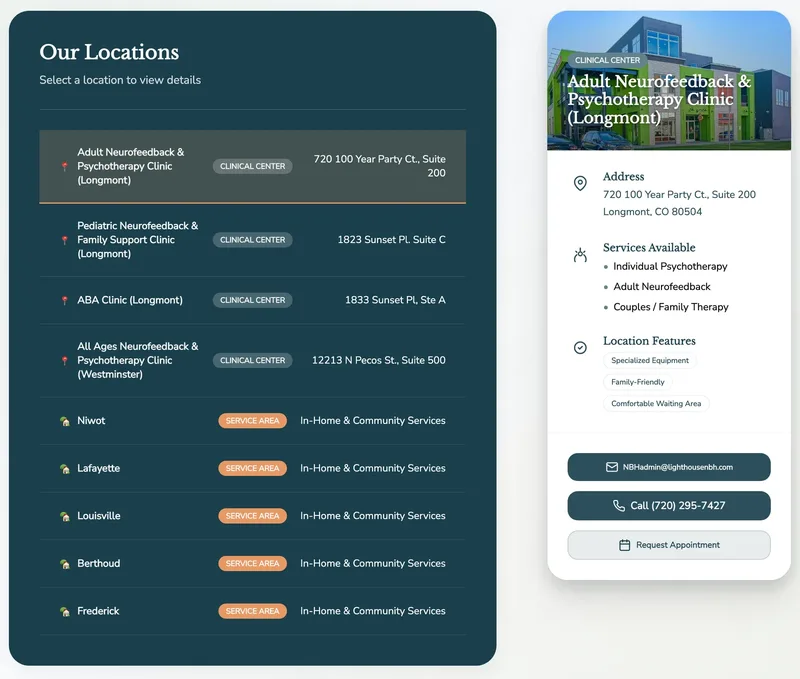
Every location and provider on one site
- 4 clinics Three in Longmont and one in Westminster, plus in-home care across five nearby towns.
- 4 services Psychotherapy, neurofeedback, family therapy and ABA, with separate menu paths for adults and for children.
- 44 clinician pages Patients can read about a clinician and choose one before booking.
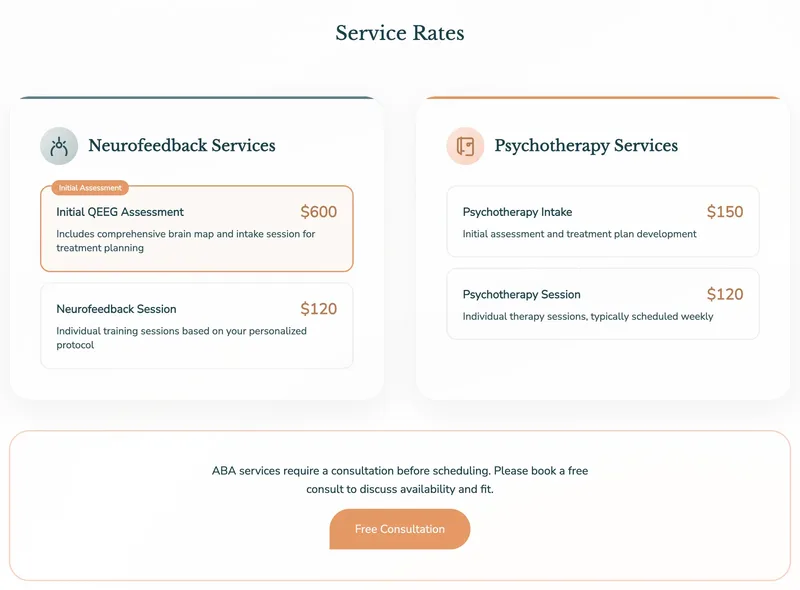
Answers before anyone has to call
- Rates up front Session prices on the page, and a free insurance check before the first visit.
- A request on every page The header on each page carries a “Request an Appointment” button.
- Old addresses forwarded Its earlier web addresses now lead to the one site.
See how it was built in the Lighthouse case study, or open lighthousenbh.com (opens in a new tab).
Source: lighthousenbh.com, checked October 13, 2026.
Accessibility now has a federal deadline
Under HHS's Section 504 rule, practices that receive HHS funding must make their websites meet WCAG 2.1 AA, so patients using screen readers, keyboards or zoomed-in text can book too. HHS names community health centers, hospitals and primary care centers among those it funds.
Websites must meet it by
- May 11, 2027 15 or more employees
- May 10, 2028 Fewer than 15 employees
Source: HHS press release, May 7, 2026 (hhs.gov).
Your compliance lead or attorney can say if the rule covers your practice. Patients on screen readers and keyboards need the site to work either way.
Most sites aren't close.
95.9% of the top million home pages failed WebAIM's 2026 accessibility check.
The three most common failures
- Unlabeled form fields 51% Fixed
- Low-contrast text 83.9% Fixed
- Missing image descriptions 53.1% Fixed
Percentages are the share of home pages with each failure. Source: WebAIM, “The WebAIM Million,” 2026 (webaim.org).
Every site we build meets WCAG 2.2 AA as standard, which covers the 2.1 AA the rule names. Text dark enough to read, fields named for screen readers, pages that work by keyboard alone and buttons big enough for a thumb are in every build, never an extra. We run each page through the testing tools accessibility auditors rely on, and the report is yours.
What it takes from your practice
Your team gives us one call, a design review and a few answers by email. We write the pages and do the rest of the medical website design while your front desk gets on with its day.
Your part at each step
-
Day one
One call
YouSpend 30 minutes telling us about the practice.
UsAsk everything we need to plan the site.
-
Within a week
A fixed price
YouRead it and decide.
UsPut the whole price in writing.
-
Next
The pages
YouSend what you already have: provider bios, services, locations, the insurance you take.
UsWrite every page from that and the call.
-
Before launch
The design
YouLook it over on a preview link.
UsBuild it in Astro, a modern way to make websites: fast on a phone, no WordPress plugins for you to update, accessible from the start.
-
About 60 days from kickoff
Launch
YouKeep seeing patients, as normal throughout.
UsTake the new site live.
-
After launch
Your updates
YouChange providers, hours, locations and insurance yourselves in a simple editor.
UsNo ticket to file and no call to wait for.
What a medical website costs
You'll never pay by the hour for medical website design with us, or for any of our web design.
Your new site, built once
$5,000–$40,000
Where most sites we build land. Yours is set as one fixed price, sent in writing within seven days of our talk.
Weigh that against what one new patient a week is worth to your practice over a year, a figure your billing already has.
What changes your price
- LocationsEach one gets its own page.
- ProvidersA profile for every one.
- ServicesA page for each kind of care.
- Old pages and domainsEach forwarded, so old links and listings still land.
Owned by your practice
Your practice owns its domain, its code and its hosting accounts, so nothing is rented month to month. Hosting with us is optional.
Tell us your locations and providers, and we'll put a number on it.
The two people behind your new site
Bullfinch has no sales staff, just these two. The call you book is with the person who will design your site and write its code, so nothing you say gets lost in a handover.
-

Kyle
Hosts your call, then designs and builds
After your 30-minute call, Kyle turns what you told him about your practice into the design and the code himself. He was making websites at 14.
-

Katie
Runs operations
Katie looks after your project, its schedule and your account, all the way from that first call to the day the site goes live. Your front desk always has one person to ask where things stand.
Source: bullfinch.io/about/.
Questions practices ask before booking
Plain answers to what owners and managers want settled before the call.
How is this different from a monthly website plan?
You pay once, at a fixed price agreed in writing, and your practice owns all of it: its domain, its code and every hosting account it runs on. There's no monthly plan fee to keep it. Hosting with us is optional; if you don't host with us, the hosting account is in your practice's own name and you pay that host yourself.
Will it bring in new patients, or only look newer?
We build each site around the two things that bring patients in: being found when people search your specialty and town, and turning a visit into a request. We won't promise you a number.
What does the site collect from patients, and is that a HIPAA problem?
The appointment request asks for three things: a name, how to reach the patient and what kind of visit they want. Nothing clinical. Medical records stay in your EHR, where they live today.
Will it meet the accessibility rule?
We build to WCAG 2.2 AA as standard, which covers the WCAG 2.1 AA that the HHS rule names. We test the pages with the tools accessibility auditors use, and you get the test report.
Does it work with our EHR, patient portal and online scheduling?
We link to the portal, bill pay and scheduling you already use; we don't connect to or replace those systems. Each one gets a clear link from the right places on the site, and no records move.
Have you built a site for a medical practice?
So far our healthcare build is Lighthouse, a behavioral health practice with four clinics. We haven't built for primary care or a specialty clinic yet. What carries over: many locations on one site, services sorted by who they're for, provider pages, rates and insurance on the page, and an appointment request on every page. Read the Lighthouse case study.
How much of my staff's time will it take?
One 30-minute call, a look at the design on a preview link, and a few answers by email. We write the pages from what you already have, so your front desk keeps its normal day.
Give us 30 minutes on your practice's website
Every month patients can't find your site for your specialty and town, they book that first visit with another practice.
Your side of the call
- Your specialty
- Each of your locations
- The kind of patients you need more of
- What you have now
What you leave with
- What we'd build for your practice
- A written, fixed price within seven days
Medical website design 30-minute intro call
Loading availability
Days with open slots
No openings
We're booked solid for the next 30 days. Drop us a line and we'll find a time outside the window.
Calendar invite is on its way to your inbox. Hit reply if anything changes.
It's a Google Meet call, and you talk to the one who'd design and code your site.