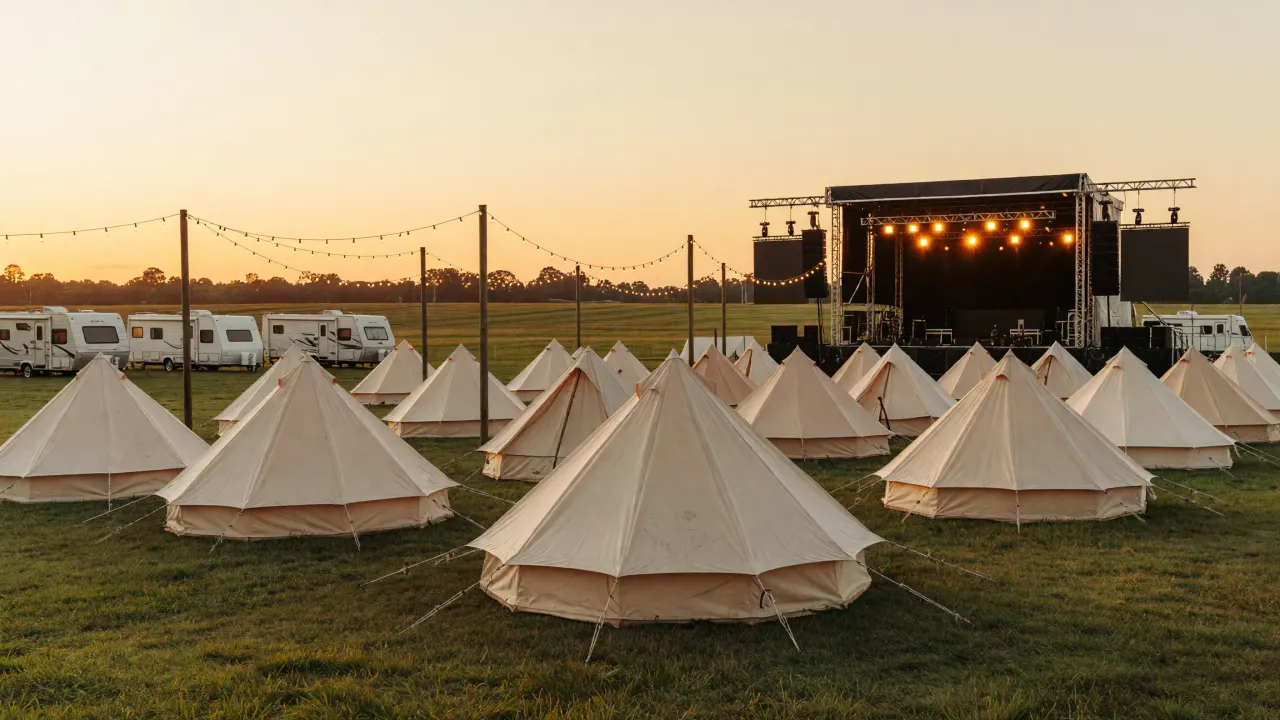
Empty festival grounds at golden hour: rows of canvas bell tents, a few RVs, string lights and a lit stage in the distance

Event website design that sells more tickets

Event website design for the festival, rodeo, fair or concert weekend you put on every year. Fans hear about it from a friend, a post or a poster, then look it up. Others search your lineup, your dates, the camping.

We build the site that shows up for those searches and makes buying a ticket, an upgrade or a campsite the obvious next tap on a phone. And you own it.

Book a call 30 minutes on Google Meet

$5,000 to $40,000, fixed in writing before we start 5.0 on Google

Your website is your box office

The ticket is only part of what a fan spends on your weekend. Then come the add-ons: the upgrade, a place to sleep, the friends they bring along, somewhere to leave the truck. And your sponsors pay to be seen by every one of those fans.

Your ticketing company runs the checkout. The choosing happens before that, on your website, so that's where all of it is sold or lost.

What one weekend sells

  • TicketsDay passes and the full weekend
  • VIPThe upgrade, priced on the same page
  • CampingTent sites, RV spots, glamping
  • Group packagesPasses for the whole crew at once
  • ParkingA pass for every car that rolls in
  • SponsorsPaying to be seen by everyone above

More people find it

Google sends people to the page that answers what they asked. Give every question a fan has about your event a clear answer on your site, and Google has a reason to send them there.

More of them buy

Once they land, the price, what's included and the button sit together, so nobody has to hunt for them on a small screen.

A lot of event sites do neither. It's one page with a date and a ticket button, or a template that hides the price a few taps deep.

Good event web design does both, and so does every site we build, from day one. The pages follow how a fan decides: who's playing, when and where, what it costs, what's included. The build follows Google's own guidance for speed, phones and structure.

A fan's year, in searches

Fans don't look your event up once. They ask one thing a month out, another the week of, and something new the day it ends. The site that answers that week's question is the one they find.

The example Stagecoach is a big country music festival in California, held every April. It's not our client. We picked it because it's big enough for the pattern to show clearly, and the year before ran the same way.

Searches a month, March to September 2026 Ahrefs estimates, US, monthly Every bar on one scale
  1. March 2026 A month out

    • stagecoach set times 182 searches

    On your site Nothing for set times yet. Almost nobody is asking.

  2. April 2026 The festival

    • stagecoach lineup 43,721 searches
    • where is stagecoach 25,134 searches
    • stagecoach tickets 18,807 searches
    • stagecoach set times 4,509 searches

    On your site The lineup, how to get there, tickets and set times, each with its own clear answer, live the week of.

  3. May 2026 Just after

    • stagecoach 2027 7,049 searches

    On your site Next year's dates, up the day after the gates close.

  4. June 2026 Two months on

    • stagecoach 2027 17,326 searches

    On your site Next year's dates, plus anything else you've announced.

  5. July 2026 The quiet stretch

    • stagecoach lineup 527 searches

    On your site The calm before the announcement: the time to get the site ready.

  6. September 2026 Lineup announced

    • stagecoach lineup 11,056 searches

    On your site The new lineup, posted the day you announce it.

Each question needs its own answer on your site, and on time: the lineup when it drops, getting there and set times the week of, next year's dates the day after.

A ticket page or a one-page site answers only your name. It has nothing for the fan asking about set times, the drive in or next year.

So we plan festival website design around the fan's year: a page for each question, ready before the week it's asked. We can't promise where Google puts it. We can make sure the answer is on your site when they ask.

Book a call about your event's year

Make the choice easy, then the button

Fans often pick a ticket on a phone, in a group chat with whoever's coming. That page is where event website design earns its keep. The day pass, the camping weekend and the group deal sit side by side: what each one includes, the price on the card, and one button straight to checkout.

Try it. Pick who's coming, and the option that fits steps forward with its button.

Who's coming?

Illustration A made-up event, prices left off
  • Day pass

    Who
    1 person
    Days
    1 day
    Camping
    Not included
    Extras
    None

    PriceYour price

  • Weekend + camping

    Who
    2 people
    Days
    All weekend
    Camping
    Tent site
    Extras
    Parking pass

    PriceYour price

  • Group package

    Who
    10 or more
    Days
    All weekend
    Camping
    Add-on
    Extras
    VIP + shuttle

    PriceYour price

The bigger tickets, like camping and group deals, are the ones worth laying out side by side: three across, the differences, then the buttons.

Checkout

Works with the ticketing company you already use

Keep the ticketing or booking company you sell through now. Every button on the site goes straight to its checkout, or opens its booking form right there on the page. Payments and inventory stay with them, where they already work.

Changes

You update it yourself

When the lineup drops, next year's dates are set or prices go up, you make the change on the site yourself, in a simple editor we hand you at launch. No waiting on us.

Speed

Quick on a phone at the gate

We build in Astro, which sends the phone a finished page with next to nothing extra to load: no plugins, no theme, no page builder. So the ticket page opens quickly, even on a weak signal in the line at the gate.

Book a call about your ticket page

Event sites we built

A country music festival that sells its passes, camping and upgrades from its own site, and a party entertainment company that takes bookings from every page. Both sites are live, so you can check everything below for yourself.

A festival that sells tickets

Cattle Country Festival

Three days of country music and camping on a 400-acre ranch in Gonzales, Texas, with three stages.

Next year's dates, already up April 8–10, 2027

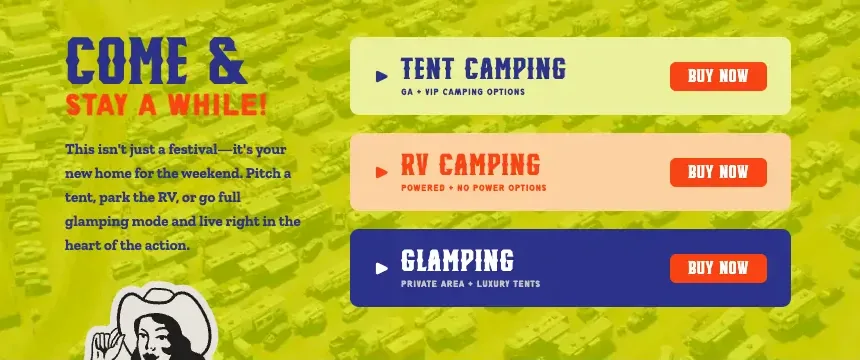
Cattle Country Festival's live site: tent camping, RV camping and glamping rows, each with an orange Buy Now button
Camping: each tier with its own Buy Now button
Lineup
Day by day, with set times.
Tickets
Every option has its price beside it and a Buy Now button that goes straight to checkout.
On sale
Day and weekend passes, 4- and 6-packs, VIP, tent and RV camping, glamping, parking.
Groups
Packages for 10+ and 12+ that come with VIP passes and private shuttles.
Getting there
Directions from Houston, Austin and San Antonio with map buttons, plus the hours and the bag policy.
Sponsors and vendors
A wall of sponsor logos, and applications for vendors and press.
See how we built Cattle Country Festival

An entertainment company that gets booked

Simply Smiles

Party entertainers in Denver: balloon artists, face painters and performers, booked for everything from birthday parties to corporate picnics.

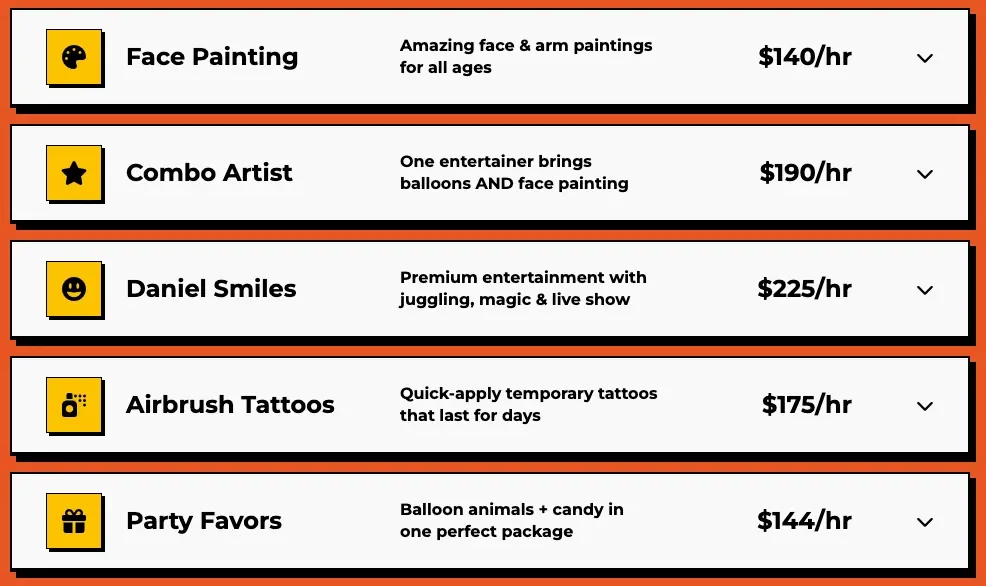
Simply Smiles' services page: face painting, combo artist, airbrush tattoos and more, each with its hourly price
Services: each one priced by the hour
Booking
Book Now sits in the header of every page and opens their booking form right there, so a parent or a planner can ask about a date from wherever they are on the site.
Prices
Each service lists its hourly rate, from $140 to $225, before anyone has to ask.
See how we built Simply Smiles

Who builds it, and what it takes from you

Bullfinch is two people, and the two of us do the work. There's no account manager in the middle and no hand-off to someone you've never met.

It all happens remotely: the call on Google Meet, the reviews on a link. Where your grounds are makes no difference.

More about Kyle and Katie
  • Kyle Rutten, who designs and builds every Bullfinch site, at his laptop in a brick-walled room

    Designs and builds it

    Kyle Rutten

    Kyle designs and builds every site we make, and he's the one you'll talk to on the intro call. He's been making websites since he was 14.

  • Katie Rutten, who runs each Bullfinch project and its schedule, at her laptop in a brick-walled room

    Runs the project

    Katie Rutten

    Katie runs your project from the first week to launch and keeps it on its dates. She does the same for thirty-plus active clients at once.

From the call to your on-sale date

  1. Day 1

    A 30-minute call

    On Google Meet, with Kyle. Your event, your tickets, and what the site has to sell.

    Your partBring your on-sale date.

  2. Within a week

    A fixed quote, in writing

    Exactly what we'll build and one price for all of it. We don't bill by the hour.

    Your partRead it, ask anything, decide.

  3. Once you say yes

    Send what you have

    We write every page from a conversation with you, so it sounds like your event, not a template.

    Your partThe lineup, ticket links, sponsor logos, photos and the map.

  4. As it's built

    Review it on a preview link

    The real site as it comes together, on your laptop or your phone.

    Your partClick through it and tell us what to change.

  5. About 60 days in

    Launch

    A typical site goes live in about 60 days, every ticket button pointing at your checkout.

    Your partShare the link.

Your on-sale date Tickets go on sale from a site that's ready for them.

So count back from the day tickets go on sale. The call belongs about two months before it, with a little room to spare. If your date is closer than that, book anyway, and Kyle will tell you plainly what can be ready.

Book a call with Kyle

What an event website costs

Here's what event website design costs with us, up front. Where your site falls in the range comes down to how much your weekend has to show and sell, and how much help you want once it's live.

Most sites we build land between $5,000 and $40,000

What moves the price for an event

  1. How many pages

    Lineup, tickets, camping or lodging, getting there, FAQ, sponsors, vendors and press. Each page a fan goes looking for is one more to write and build.

  2. How many ticket types and packages

    Day passes, the weekend, VIP, camping tiers, group deals. Every option gets its price, what's in it and its own button to your checkout.

  3. A sponsor wall

    Your sponsors' logos on a page of their own, which you add to yourself as new ones sign on.

  4. An email list for next year

    A sign-up on the site that gathers this year's fans, ready for the day you announce next year's dates.

  5. More than one event or venue

    A second weekend or a second set of grounds brings its own dates, tickets and directions.

  6. Ongoing SEO or Google Ads

    Optional, after launch, for help bringing more fans in from Google. Add either one and it's part of the price.

You pay for the build, not a rental

The domain, the code and the hosting accounts belong to you. Nothing switches off when the gates close: the site keeps working between events, ready for next year's dates and the new lineup.

No hourly meter

Within a week of the call, you get the whole scope in writing with one fixed price on it. It doesn't climb while we work.

After launch, you choose

We can host the site and keep it updated for you. Or we hand it over clean, and you run it from there.

Your quote starts with a 30-minute call with Kyle. Book a call

Questions event organizers ask before they book

Short answers to what's still open once the price is on the table: your ticketing company, the changes you'll make yourself, the months between events, and who owns what.

Ask Kyle anything else on the call

I already sell through a ticketing company. Why do I need a website?

Because a ticketing page only sells to people who already have the link. Fans who search your lineup, your dates or the camping get sent to whatever answers them, and that should be your own site. It's also the home for your sponsors and for next year's date.

Will it work with the ticketing or booking system I already use?

Yes. We link to it or embed it, and it goes on handling payments and inventory exactly as it does now. On Cattle Country Festival's site, every Buy Now button sends the fan to the festival's checkout with its ticketing company. On Simply Smiles' site, the Book Now button opens their booking form in a window over whatever page you're on.

Can I change the lineup, dates and sponsors myself?

Yes, in a simple editor we set up for you. New acts, set times, next year's dates, the prices shown on the site and sponsor logos are all yours to change, whenever you like. The tickets themselves, and how many are left, stay with your ticketing company.

My event is one weekend a year. Is a website worth it the rest of the time?

Yes, because searches for next year start as soon as this year's gates close, as the fan's year above shows. A site with next year's dates already up is there for those fans, and ready for the lineup news and the on-sale date that follow.

Have you built websites for events before?

Yes, two, and both are live. For music festival website design, see Cattle Country Festival: three days of country music and camping in Texas, with the lineup by day, every pass and campsite priced, and directions with map buttons. For bookings, see Simply Smiles, party entertainers in Denver who take booking requests from every page of their site.

Do I own the site?

Yes, it's yours. Your domain, the site's code and the hosting accounts are all in your hands, and you're free to move the site to another developer whenever you want.

Do I need SEO or ads on top of the site?

Not to start. Every site we build goes live ready for Google: quick to open on a phone, with a page for each thing fans look up, built so Google can read it. If you want more fans arriving from Google after launch, we also offer ongoing SEO and Google Ads, both optional.

Book 30 minutes about your event website

Tell us about your event and when tickets go on sale. We'll say what we'd build for it and roughly what that takes. The price follows inside a week: fixed, and written down.

Why it's worth booking now

60 days
About how long a typical site takes, from your go-ahead to launch.
The week it ends
When fans start searching for next year's dates. Your site should already have them.

Event website design runs on your event's calendar. Talk to us early, and the site is live and ready before fans come looking.

30 minutes on Google Meet, with Kyle

Loading availability

Rather talk now? Call 720-299-8584 5.0 on Google

This page is about events. For how we design and build sites for any business, see web design.